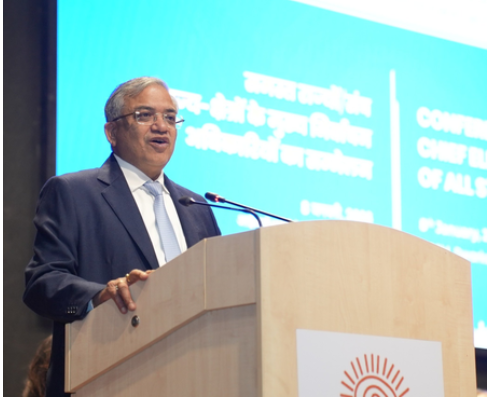
The Election Commission of India is set to host the India International Conference on Democracy and Election Management (IICDEM) 2026 in New Delhi, positioning the national capital as a global hub for discussions on electoral governance, democratic practices and institutional innovation. The three-day conference will begin on January 21 at Bharat Mandapam and conclude on January 23.
Organised by the India International Institute of Democracy and Election Management, the conference is being described by the Election Commission as the largest global gathering hosted by India in the domain of democracy and election management. The event is expected to bring together nearly 100 international delegates representing more than 70 countries, along with officials from international organisations, members of foreign missions based in India, and academic and practising experts from the electoral field.
Chief Election Commissioner Gyanesh Kumar, along with Election Commissioners Sukhbir Singh Sandhu and Vivek Joshi, will receive the delegates and formally flag off the proceedings at the inaugural session on January 21. The presence of senior election officials is expected to underscore India’s institutional engagement with global electoral bodies and its role in sharing administrative and technological experiences from large-scale elections.
The programme structure includes a series of general and plenary sessions involving Election Management Bodies from different regions. These include the inaugural session, an EMB leaders’ plenary, EMB working group meetings and thematic sessions that will focus on global electoral challenges, evolving international electoral standards, and innovations and best practices in election processes.
A key feature of the conference will be the formation of 36 thematic groups, each led by Chief Electoral Officers from States and Union Territories. These groups will be supported by national and international academic experts and are expected to facilitate detailed discussions on specific aspects of election management, including voter registration, election logistics, technology use and institutional transparency.
Academic participation will form a significant component of the deliberations, with leading institutions contributing to discussions. These include four Indian Institutes of Technology, six Indian Institutes of Management, twelve National Law Universities and the Indian Institute of Mass Communication, reflecting an interdisciplinary approach to electoral studies and democratic governance.
Alongside multilateral discussions, the Election Commission has scheduled more than 40 bilateral meetings with Election Management Bodies from participating countries. These engagements are intended to deepen cooperation and exchange perspectives on common challenges faced by election authorities worldwide, including operational complexity, voter participation and trust in electoral systems.
During the conference, the Commission will formally launch ECINET, a unified digital platform designed to serve as a one-stop interface for election-related information and services. Officials indicated that the platform aims to improve accessibility, integration and transparency in election administration.
An exhibition will also be organised alongside the conference, showcasing the scale and complexity involved in conducting elections in India. The exhibition will highlight recent initiatives undertaken by the Election Commission to strengthen the preparation of electoral rolls and the conduct of elections, two pillars central to the credibility of the electoral process.
In addition, a docuseries titled India Decides will be screened on the opening day of the conference. The series documents the making of the Lok Sabha 2024 elections, offering insights into the logistical, administrative and technological dimensions of managing the world’s largest democratic exercise.
With participation spanning continents and institutions, IICDEM 2026 is being positioned as a platform for sustained dialogue on democracy and election management. The conference reflects India’s efforts to engage globally on electoral governance while drawing on its experience of conducting elections at an unparalleled scale.