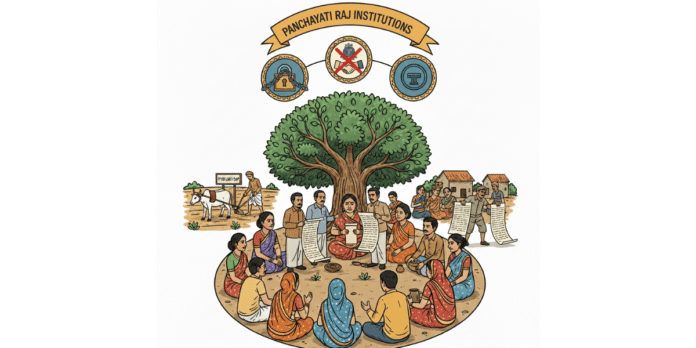
Concerns over potential dilution of Panchayat autonomy and weakening of cooperative participation have been formally raised with Union Home Minister and Minister of Cooperation Amit Shah regarding the draft Andaman & Nicobar Islands (Grant-in-Aid to Panchayati Raj Institutions) Rules, 2025. The draft, issued under Section 202 of the Andaman & Nicobar Islands (Panchayats) Regulation, 1994, has drawn attention for its possible constitutional and decentralisation implications.
The representation argues that while transparency, audit discipline and alignment with General Financial Rules 2017 and e-procurement standards are necessary, reforms must not compromise the foundational principles of decentralised governance. It underscores that accountability in public expenditure should operate within the constitutional framework that protects local self-government.
At the centre of the issue lies the spirit of the 73rd Constitutional Amendment, which established Panchayats as institutions of self-government. Financial devolution and operational autonomy constitute core elements of Part IX of the Constitution. The draft framework’s proposal to mandate limited tender processes and additional procedural layers, even for smaller works, combined with expanded bureaucratic oversight, is seen as risking substantive autonomy of Panchayati Raj Institutions in the Islands. The submission stresses that reform must deepen decentralisation rather than inadvertently centralise authority.

The draft’s implications for the cooperative movement have also been highlighted as a major concern. The earlier system in the Islands enabled unemployed cooperative societies to undertake development works. This approach supported local employment generation, retained economic value within villages and strengthened grassroots institutional capacity. The proposed transition to a contractor-style empanelled limited tender regime, without transitional safeguards or preference mechanisms for local cooperatives, may reduce cooperative participation and discourage community-based institutional growth. Given the Islands’ unique geographic, demographic and economic realities, the submission calls for a calibrated review.
Questions have also been raised over the proposed empanelment process. The draft introduces “empanelled agencies” but does not clearly outline objective eligibility criteria, transparent evaluation standards, appeal or review mechanisms, or public disclosure safeguards. The absence of defined procedural clarity may expose the process to allegations of arbitrariness or favouritism, potentially undermining confidence in Panchayati Raj reforms.

Another key issue concerns the proposed uniform ₹10 lakh cap on Zilla Parishad sanctioning powers. The reduction from previous thresholds has been described as regressive in view of the scale and responsibilities at the district level. The submission seeks reconsideration of this provision.
To address these concerns, the representation proposes transitional protection for existing cooperative societies, weightage or preference for locally registered cooperatives, simplified procurement norms for very small-value works, clearly notified empanelment guidelines and the establishment of a formal grievance redress mechanism. It also recommends incorporating a clarificatory provision in the final rules to ensure that Panchayati Raj autonomy under Part IX of the Constitution and the cooperative institutional framework remain intact.
The concerns were raised by Member of Parliament from Andaman and Nicobar Islands, Bishnu Pada Ray, who has sought intervention to ensure that the highlighted issues receive due consideration before the draft Grant-in-Aid Rules, 2025 are finalised.


