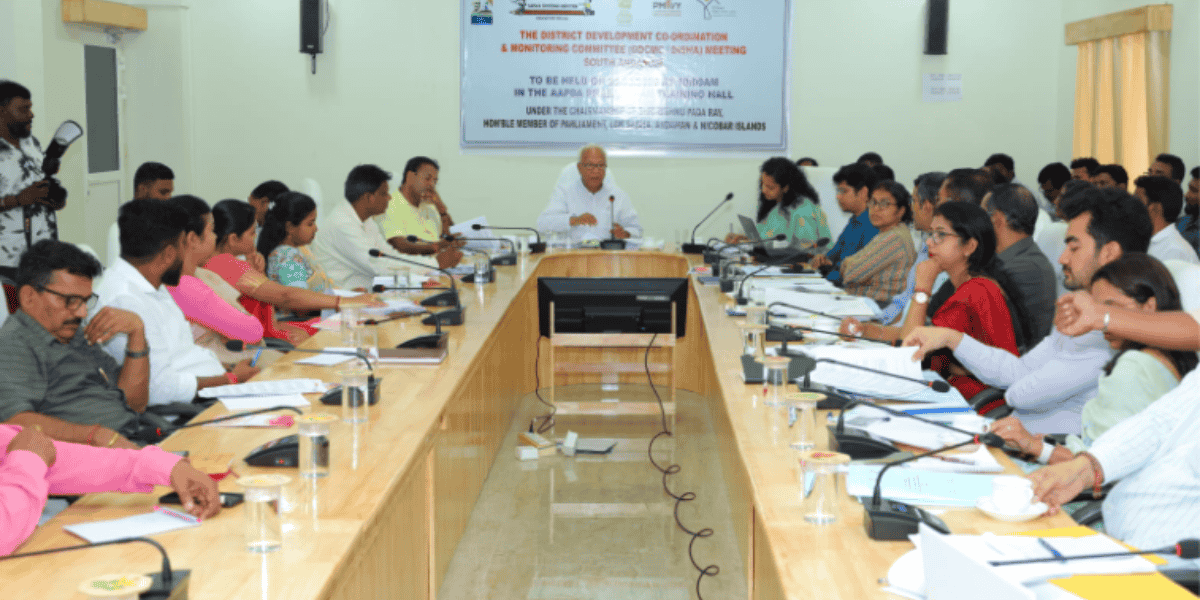
The District Development Coordination and Monitoring Committee (DDCMC), also known as DISHA, met in Sri Vijaya Puram to review the progress and implementation of key development schemes across South Andaman, with emphasis placed on coordination, accountability and timely execution.
The meeting was chaired by Bishnu Pada Ray, Member of Parliament for Andaman and Nicobar Islands, and attended by senior district officials, representatives of Panchayati Raj Institutions and heads of departments involved in development and service delivery. The review was held at the conference hall of the Disaster Management facility, South Andaman.
Officials present included the Deputy Commissioner of South Andaman, the Adhyaksh of the Zilla Parishad, and representatives from various line departments responsible for implementing central and Union Territory government schemes. The session focused on strengthening institutional mechanisms for monitoring programmes that cut across sectors such as infrastructure, welfare delivery and local governance.

During the deliberations, emphasis was laid on the constitutional framework governing the roles and responsibilities of the Central Government, the Union Territory Administration and local self-governments. The need for effective convergence between departments and Panchayati Raj Institutions was highlighted as a key factor in ensuring that schemes reach intended beneficiaries without delays or duplication.
The Member of Parliament stressed the importance of collaborative governance, underlining that development outcomes depend not only on funding but also on coordination between departments and adherence to timelines. Officials were reminded of the need to track physical and financial progress regularly and to address bottlenecks that slow implementation at the ground level.
Concerns relating to monitoring gaps and follow-up mechanisms were also discussed, with directions issued to strengthen reporting systems. The Deputy Commissioner of South Andaman directed all departments to submit a detailed report within one week outlining observations made during the meeting and the specific actions initiated in response. Departments were informed that failure to comply within the stipulated timeframe would invite appropriate action.
The meeting also reviewed the status of ongoing schemes and projects, assessing whether targets were being met and whether corrective measures were required. Officials were advised to maintain updated records and ensure that field-level data reflects actual progress, particularly in sectors where delays tend to have cascading effects on service delivery.

Participants from Panchayati Raj Institutions flagged the importance of local feedback in refining implementation strategies, noting that grassroots inputs often reveal operational challenges not visible at the administrative level. The role of elected local bodies in monitoring and social auditing of schemes was acknowledged as essential for improving transparency and accountability.
The DISHA platform, designed as a high-level coordination mechanism, was described by officials as critical for aligning district-level execution with parliamentary oversight. Regular meetings were seen as necessary to ensure that development priorities remain responsive to changing needs and that corrective interventions are taken in time.
The meeting concluded with clear instructions for sustained monitoring, periodic review and structured follow-up to accelerate development outcomes in South Andaman. Departments were asked to treat the directions issued during the meeting as time-bound and outcome-oriented, with a focus on improving efficiency and service delivery across sectors.