The attempted Iranian missile strike on the U.S.-U.K. base at Diego Garcia has underlined a hard strategic truth: in the Indian Ocean, geography is still power. Diego Garcia matters because it is an unsinkable platform in the middle of a vast oceanic battlespace, allowing long-range surveillance, bomber operations, naval support and sustained military reach. Its continued relevance, decades after the Cold War, is a reminder that island bases are not relics. They are central to how modern powers see, deter and, if needed, fight across the Indo-Pacific.
For India, that lesson points directly to the Andaman and Nicobar Islands. They are not India’s version of Diego Garcia in a literal sense; the geographies are different and so are the missions. Diego Garcia sits deep in the central Indian Ocean, roughly midway between major chokepoints, which is what gives it extraordinary reach westward toward the Gulf and eastward toward Southeast Asia. The Andaman and Nicobar chain, by contrast, is valuable because it sits near the western approaches to the Strait of Malacca, one of the world’s most important maritime chokepoints. In strategic terms, Diego Garcia is a mid-ocean fortress; Andaman and Nicobar is a forward gatekeeper.

That gatekeeper role is becoming more important, not less. The U.S. Energy Information Administration identifies the Strait of Malacca as one of the world’s most important oil transit chokepoints, while recent trade analysis has described it as the largest oil transit chokepoint globally by share of maritime oil trade. Any serious disruption there would ripple through Asian energy flows, shipping costs and military planning. The Andaman and Nicobar Islands therefore give India what few countries possess: proximity to a strategic valve of the global economy.
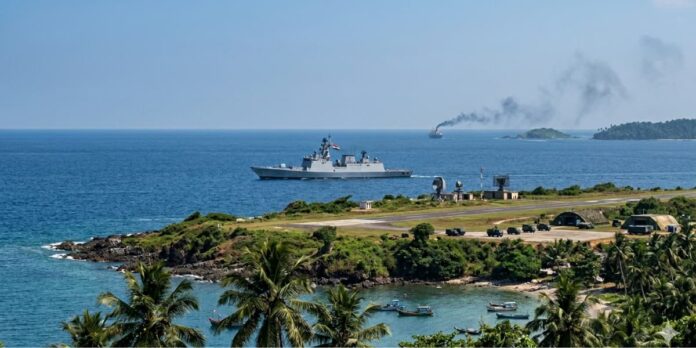
India’s own force posture already reflects this logic. The Andaman and Nicobar Command, headquartered at Sri Vijaya Puram, is India’s first and only joint services operational command, integrating the Army, Navy, Air Force and Coast Guard in a theatre that the government itself describes as strategically vital to the Indian Ocean region. That is not bureaucratic symbolism. It is an institutional acknowledgment that the islands are central to surveillance, deterrence, maritime domain awareness and joint-force readiness.
What Diego Garcia has demonstrated in recent days is that island bases are valuable not just because they sit near sea lanes, but because they combine location with infrastructure. A useful island base needs long runways, dispersal areas, hardened fuel and ammunition storage, reliable communications, maritime patrol assets, air defence, repair capability and political clarity about its military role. Diego Garcia has long offered that kind of depth, which is why it has remained useful from the Gulf War to operations in Afghanistan, Iraq and now in the latest Middle East crisis.
That is precisely where India’s Andaman and Nicobar strategy still has room to evolve. The islands already offer India a priceless positional advantage, but position without capacity is only half a strategy. The next phase has to be about turning proximity into sustained operational leverage: better airfield capacity, stronger logistics chains, more persistent ISR coverage, improved anti-submarine capabilities, stronger missile and air defence, and better inter-island connectivity for rapid force movement. Some of that thinking is visible in the government’s push around Great Nicobar, including the transshipment port and airport-linked development. The government has repeatedly stressed the strategic and trade logic of Galathea Bay, noting its location on international shipping routes and its role in reducing India’s dependence on foreign transshipment hubs.
But the Diego Garcia comparison also contains a warning. The value of an island base makes it a target. Reuters and other reports on the March 21 missile incident show that adversaries are increasingly willing to signal or attempt long-range strikes on distant island facilities. That means India cannot think of the Andamans only as a lookout post; it must think of them as defended strategic infrastructure. In the missile age, remoteness is no longer protection by itself.

There is another difference worth noting. Diego Garcia is essentially a military platform. The Andaman and Nicobar Islands are much more than that: they are inhabited, ecologically fragile and politically sensitive. India cannot, and should not, treat them as a bare strategic outpost. Its approach has to balance national security with environmental caution, local livelihoods and the specific sensitivities of island development. That makes India’s task harder than the Diego Garcia model, but also more legitimate and more sustainable over time. The strategic case for stronger infrastructure in the islands is real; so is the need for restraint and intelligent planning.
The larger point is simple. Diego Garcia has reminded the world that the Indian Ocean is no backwater. It is a contested strategic arena where bases, chokepoints and sea-lane access can shape both war and commerce. For India, the clearest implication is that the Andaman and Nicobar Islands are no peripheral territory. They are one of the country’s most consequential strategic assets. If Diego Garcia is proof that island geography can anchor power projection, the Andamans are proof that India sits astride one of the key hinges of the Indo-Pacific. The real question now is whether New Delhi will build the infrastructure, doctrine and political focus needed to use that advantage fully.