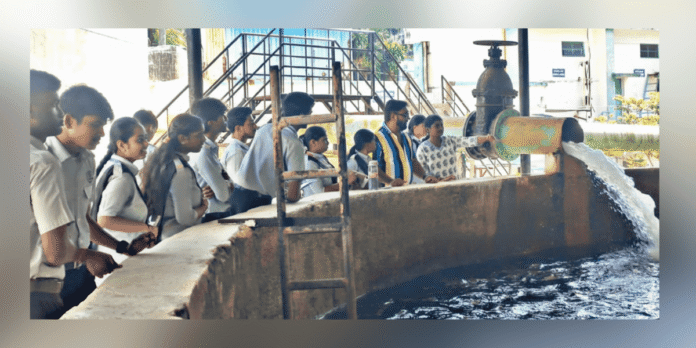
B.Tech Civil Engineering students of Dr. B.R. Ambedkar Institute of Technology (DBRAIT) participated in an academic field-based learning programme focused on understanding municipal water treatment systems, reinforcing the application of classroom knowledge to real-world engineering practices.
The educational engagement was designed to strengthen students’ conceptual clarity on core water treatment processes that form the backbone of urban water supply infrastructure. As part of the programme, students studied the operational principles and sequential functioning of key treatment stages, including aeration, sedimentation, coagulation, clariflocculator units, rapid sand filtration, and sludge removal systems.
The exposure enabled students to observe how theoretical concepts taught in environmental and water resources engineering are applied at scale to ensure safe and sustainable water supply. By examining live operational units, students gained insight into process efficiency, system integration, and challenges involved in municipal water management.

Faculty members highlighted that such academic exercises are critical in preparing civil engineering students for professional responsibilities, particularly in the context of sustainable infrastructure development and public health protection. Understanding water treatment processes is considered a foundational competency for civil engineers, given the increasing demand for resilient and environmentally responsible urban services.
The initiative was planned as part of outcome-based education (OBE) and aligned with the National Education Policy (NEP), with an emphasis on experiential learning and skill-based education. The programme aimed to bridge the gap between theoretical instruction and practical application, enabling students to connect academic learning outcomes with industry-relevant practices.
Altamash Mustafa, Training and Placement Coordinator and Associate Dean, IQAC, DBRAIT, coordinated the academic activity as an innovative teaching pedagogy. The structured approach focused on enhancing analytical thinking, technical observation skills, and system-level understanding among students, which are essential for modern civil engineering practice.

According to faculty involved, exposure to real-time water treatment operations also helps students appreciate the role of engineering in addressing sustainability concerns, resource management, and service delivery in growing urban centres. The learning outcomes included improved comprehension of treatment workflows, design logic, and operational constraints encountered in public infrastructure projects.
The programme reflects DBRAIT’s continued emphasis on integrating field-based learning within the curriculum to improve graduate readiness and align engineering education with national academic reforms. Such initiatives are increasingly being adopted across technical institutions to ensure that graduates possess not only theoretical knowledge but also practical understanding relevant to professional environments.
By prioritising educational value over routine site exposure, the activity reinforced the importance of applied learning in engineering education, particularly in sectors critical to public welfare such as water supply and sanitation.