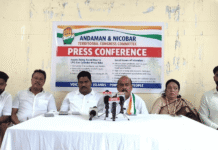
The Congress has expressed concern over reports alleging that tribal communities in Great Nicobar are being pressured by the district administration to surrender ancestral land for the Rs 92,000 crore infrastructure project on the island, describing the development as unacceptable and environmentally damaging.
The issue was raised after media reports suggested that tribal residents were being asked to part with land as part of the implementation of the Great Nicobar Island project. Reacting to these reports, senior Congress leader Jairam Ramesh described the project as an ecological disaster and said the manner in which it was being pursued reflected a disregard for environmental and social safeguards.
The allegations come amid ongoing legal scrutiny of the project. Petitions related to the Great Nicobar development are currently being heard in the Calcutta High Court and the National Green Tribunal. Concerns have also been voiced by professionals and environmental experts, though the Congress has argued that these objections have not resulted in meaningful changes to the project’s execution.
The Union Ministry of Environment, Forest and Climate Change has, however, rejected claims that the project poses unchecked environmental risks. According to official records from 2024, the ministry stated that the decision to proceed with the development was taken after detailed consideration of its potential ecological impact, alongside its strategic, defence and national importance.
As per the Environmental Impact Assessment notification of 2006, prior environmental clearance is mandatory for large infrastructure projects. The ministry has said that the Great Nicobar project underwent the full clearance process, including screening, scoping, public consultation and appraisal, before approvals were granted.
The Environmental Impact Assessment and Environmental Management Plan for the project were prepared following studies conducted by several statutory and non-statutory bodies. These included the Zoological Survey of India, Salim Ali Centre for Ornithology and Natural History, Wildlife Institute of India and the Indian Institute of Science. The studies assessed the potential impact on terrestrial and marine ecosystems and proposed mitigation measures.
In addition, institutions with specialised technical expertise, such as Indian Institutes of Technology, the National Institute of Ocean Technology, the National Centre for Coastal Research and the National Institute of Oceanography, were involved during the appraisal stage. The ministry said the EIA and EMP reports were subjected to detailed scrutiny by an independent Expert Appraisal Committee comprising experts from science and engineering fields.
The environmental clearance granted for the project includes 42 specific conditions covering various components of the development, aimed at safeguarding biodiversity and managing ecological risks. To monitor compliance, three independent committees have been constituted to oversee pollution-related issues, biodiversity protection, and the welfare of the Shompen and Nicobarese communities.
A High-Power Committee was also formed by the ministry following an order of the National Green Tribunal dated April 3, 2023, to further oversee aspects of the project’s implementation.
While the government maintains that adequate safeguards are in place, the Congress has continued to question the manner in which the project is being executed, particularly in relation to tribal land rights and ecological sensitivity. The issue is expected to remain under close legal and political scrutiny as the project progresses.