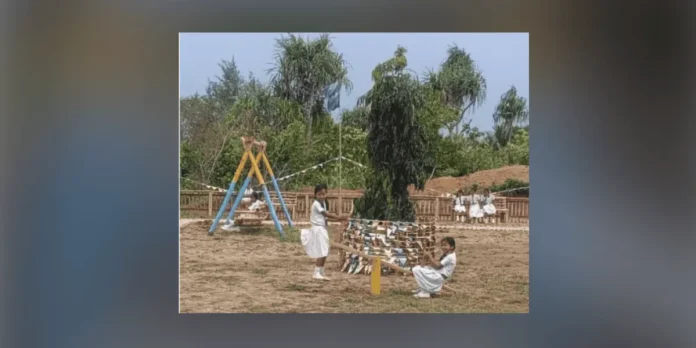
A traditional eco-friendly children’s park-cum-fitness track has been inaugurated in Pilpillow village of the Nicobar Islands, addressing a long-standing gap in basic recreational infrastructure in the remote tribal settlement.
The facility was formally dedicated to public use at Nancowry in the presence of administrative and community representatives. The project was implemented under the flagship rural development programme of the Ministry of Rural Development, Government of India, as part of efforts to create durable community assets while supporting local employment.
Pilpillow village, located around 31 km from the administrative headquarters and falling under the Kamorta Tribal Council, had lacked dedicated recreational facilities for children for several years. Recognising the need for a safe and inclusive play area, the project was conceptualised to combine recreation, fitness and community use in a single space.

The park was constructed using eco-friendly and locally available materials, integrating traditional design elements in line with the cultural context of the village. Officials said the approach ensured environmental sustainability while also preserving local aesthetics and construction practices.
The project was executed at a cost of ₹2.99 lakh and generated 809 mandays of employment under the employment guarantee programme. According to officials, the dual objective of livelihood support and asset creation reflects the broader intent of rural development schemes in tribal and remote regions.
The newly created facility is expected to provide a safe and engaging environment for children, while also encouraging physical activity and healthy lifestyles among residents. Community members said the park would serve as a shared space for recreation, fitness and social interaction.
During the inauguration, emphasis was placed on the importance of community ownership in maintaining the asset. Residents were urged to ensure that the space is kept clean and used responsibly so that it continues to benefit future generations.
The initiative was presented as an example of collaborative governance involving district administration, block-level officials and village leadership. Officials noted that such projects demonstrate how decentralised planning and local participation can result in infrastructure that is both functional and socially relevant.

The park-cum-fitness track also reflects a growing focus on inclusive public infrastructure in tribal areas, where access to basic amenities often lags behind mainland regions. Administrators said similar initiatives are being explored in other remote villages to improve quality of life and social cohesion.
Community representatives expressed appreciation for the creation of a common facility that caters specifically to children and youth, a demographic often underserved in infrastructure planning in isolated areas. They said the project has added value beyond recreation by strengthening community bonding.
Officials said the successful execution of the project underscores the effective use of rural employment programmes in the Nicobar Islands, particularly in creating assets that respond directly to local needs. The initiative has been positioned as a model for integrating livelihood generation with long-term community development.