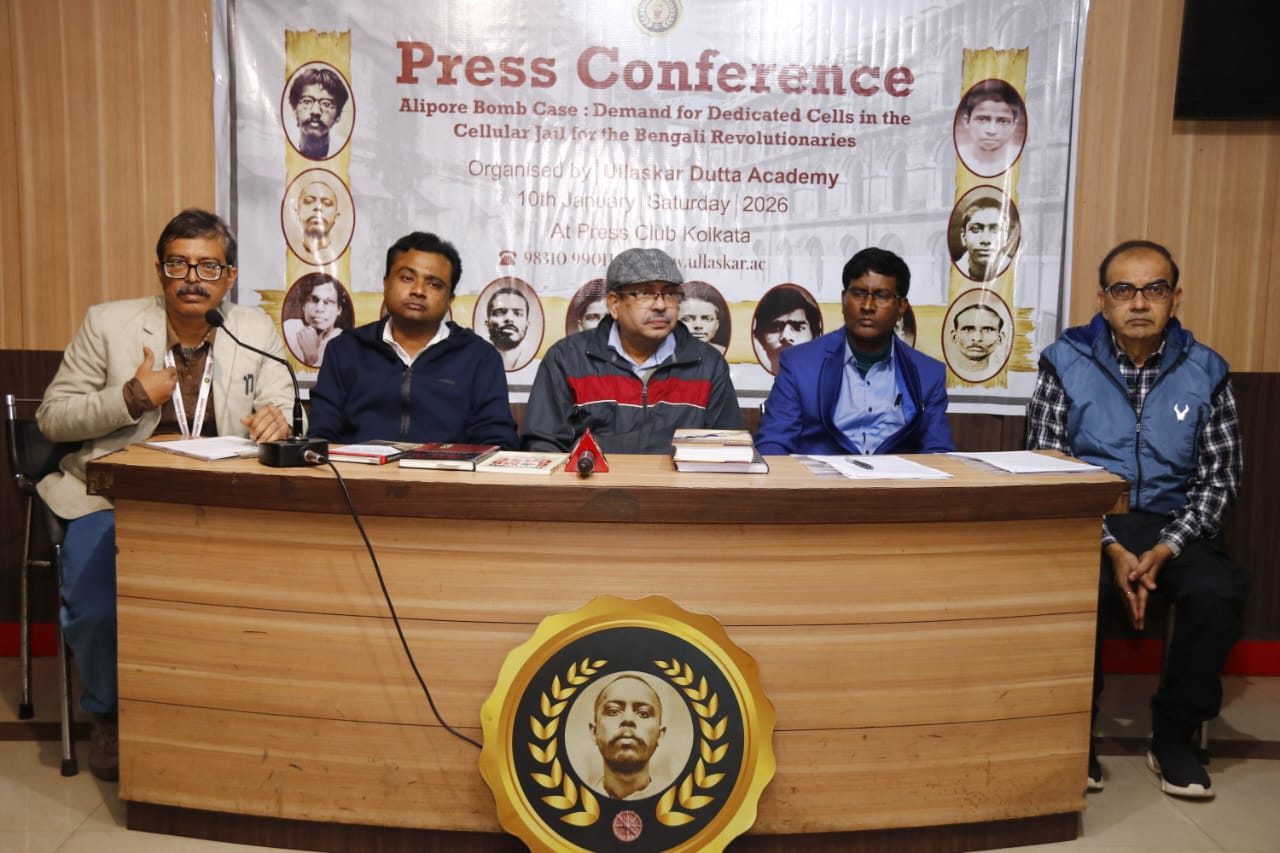
The Ullaskar Dutta Academy, a research collective named after veteran freedom fighter Ullaskar Dutta, has appealed to the Union government and the Andaman & Nicobar Administration to dedicate separate cells at the historic Cellular Jail to 12 Bengal revolutionaries who formed the first batch of political prisoners deported to the Andamans during the British era.
Addressing the media in Kolkata, representatives of the academy said the demand seeks to formally recognise a “missing chapter” of India’s freedom struggle, particularly the sacrifices of Bengal revolutionaries who were among the earliest to be sent to Kalapani following the Alipore Bomb Conspiracy case.
According to the academy, the group of 12 revolutionaries was deported to the Cellular Jail after being convicted for politically motivated crimes, marking the first large-scale transfer of political prisoners to the Andamans. Many of them were subjected to solitary confinement, forced labour and severe physical punishment.

At present, two cells in the Cellular Jail are dedicated to freedom fighters Vinayak Damodar Savarkar and Sachindranath Sanyal. The academy has urged the Centre to similarly earmark cells in memory of the Bengal revolutionaries to ensure their contributions are preserved and presented to future generations.
Subhra Kanti Gupta, managing trustee of the Ullaskar Dutta Academy, said recognising the “maiden batch” of political prisoners was essential to restore balance to historical narratives. “These revolutionaries were among the earliest political prisoners sent to Kalapani. Their lives and sacrifices represent a vital chapter of the freedom movement, but their contributions have largely been erased from mainstream discourse,” he said.
The revolutionaries deported to the Andamans included Ullaskar Dutta, Hem Chandra Das, Abinash Chandra Bhattacharya, Upendra Nath Banerjee, Bibhuti Bhushan Sarkar, Indubhushan Roy, Paresh Chandra Moulik, Hrishikesh Kanjilal, Biren Chandra Sen, Sudhir Kumar Sarkar, and Nirapada Roy. Another prominent figure associated with the Alipore Bomb case was Barindra Kumar Ghosh. The movement also drew inspiration from iconic figures such as Khudiram Bose, Kanailal Dutta, and Satyendranath Bose.
Gupta said the 12 prisoners were the first large group convicted for revolutionary activities and sent to the Cellular Jail. “They were confined in isolated cells and subjected to gruelling labour and torture for even minor acts of disobedience. Their suffering laid the foundation for later waves of political resistance,” he added.
Academy advisor Prasanta Paul said there was an urgent need to reassess India’s freedom struggle by foregrounding the role of Bengal’s revolutionaries. “They were youth icons of their time who sacrificed everything for the motherland. Dedicating cells in their names would not only honour them but also help young visitors understand the diversity and depth of India’s freedom movement,” he said.
The demand was formally communicated through letters addressed to Prime Minister Narendra Modi, Union Minister for Culture Gajendra Singh Shekhawat, the Curator of the Cellular Jail, West Bengal Chief Minister Mamata Banerjee, and the Andaman & Nicobar Administration. The academy said the letter sent to the Union government has already been acknowledged.

Those present at the press conference included Subhro Kanti Gupta, managing trustee; Amitava Dutta, coordinator for social outreach; Dr Manas Das, research head; and advisors Ashok Kumar Mukhopadhyay and Prasanta Paul.
The Cellular Jail, now a national memorial and major heritage site in the Andamans, attracts thousands of visitors each year. Historians and researchers have long argued that while the jail symbolises colonial repression, many revolutionary figures who endured imprisonment there remain underrepresented in its official narrative.
The academy said dedicating separate cells to the Bengal revolutionaries would serve both as a historical correction and an educational initiative, ensuring that the stories of early revolutionaries deported to the Andamans are remembered alongside more widely recognised freedom fighters.