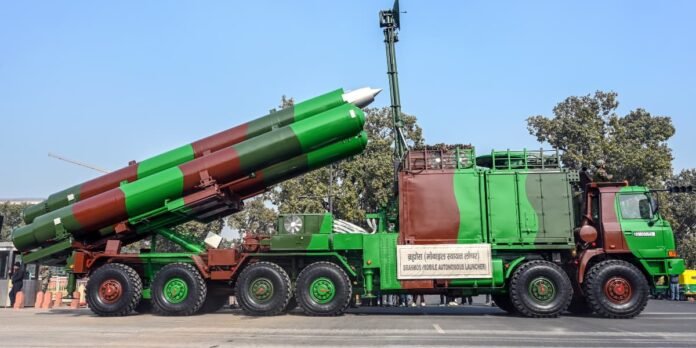
New Delhi, April 11: India’s BrahMos supersonic cruise missile is witnessing growing interest across Southeast Asia, as regional nations seek to strengthen their defence capabilities amid rising tensions in the South China Sea and concerns over China’s expanding naval presence.
The missile, jointly developed by India and Russia, has emerged as a key component in India’s defence outreach, with its speed, precision strike capability and multi-platform deployment enhancing its appeal among countries in the Indo-Pacific region.
With speeds ranging between Mach 2.8 and Mach 3, the BrahMos missile surpasses many conventional cruise missiles currently deployed by naval forces globally. It offers a strike range exceeding 400 kilometres and can be launched from land, sea, air and submarine platforms, making it a versatile system for modern warfare.

The increasing interest comes as Southeast Asian littoral states look to strengthen their deterrence capabilities in response to China’s assertive posture in the region. The overlapping territorial claims in the South China Sea have prompted countries to adopt strategies aimed at enhancing Anti-Access and Area Denial capabilities.
Countries such as Vietnam, the Philippines and Indonesia are emerging as key players in this evolving security landscape. Analysts note that while China’s naval forces have developed significant A2/AD capabilities, systems like BrahMos enable smaller nations to build comparable defensive strength.
The demand for such systems has also been influenced by shifting geopolitical dynamics. The ongoing conflict in West Asia has led to a perceived redeployment of US military assets away from the Indo-Pacific, raising concerns among regional allies about defence preparedness and security guarantees.
Reports indicate that Southeast Asia has received limited emphasis in the US National Security Strategy 2025, prompting countries in the region to diversify defence partnerships and seek alternative sources of military support.

In this context, India has expanded its strategic engagement with Southeast Asia through defence exports and cooperation. Indonesia’s recent decision to procure the BrahMos missile reflects this shift, following an earlier delivery to the Philippines in 2024. India is also reportedly moving closer to finalising a deal with Vietnam valued at approximately $700 million.
India, along with partners such as Japan and South Korea, is offering capacity-building initiatives, training and technological cooperation to strengthen regional defence capabilities.
The growing interest in BrahMos underscores India’s expanding role in the Indo-Pacific security architecture, as countries in Southeast Asia look to enhance their strategic autonomy and preparedness in an evolving geopolitical environment.