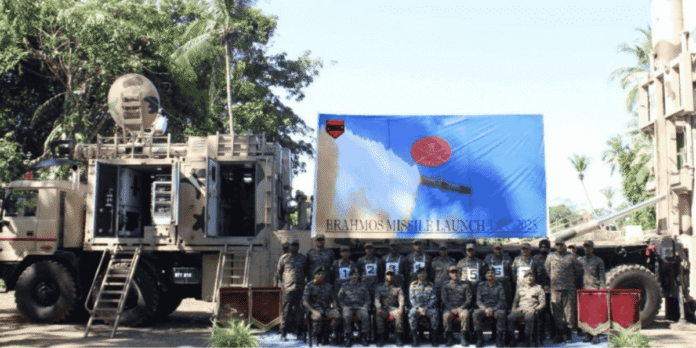
A combat launch of the BrahMos supersonic cruise missile over the Bay of Bengal has once again underlined India’s rapidly advancing long-range strike capabilities, with the Indian Army successfully executing a high-precision hit under simulated battlefield conditions. The launch, carried out this week by the Southern Command with operational support from the Andaman & Nicobar Command, demonstrated the missile’s accuracy, speed and reliability in a realistic combat environment.
According to official inputs, the BrahMos system “roared across the Bay of Bengal,” travelling at supersonic velocity before striking its designated target with pinpoint precision. The test was conducted to validate the Army’s long-range strike readiness, an area of increasing emphasis as India continues to strengthen its Aatmanirbhar defence ecosystem. The trial was aimed at assessing how the missile performs in real-time battlefield simulations, including complex environmental and operational variables.

The Army said the direct hit achieved in this test reaffirmed the force’s capacity to undertake decisive precision engagements at extended ranges. Such demonstrations have become central to India’s broader defence preparedness, particularly as BrahMos remains one of the country’s most advanced and strategically significant weapon systems. Designed for rapid response and high-impact strikes, the missile’s combination of speed, accuracy and destructive capability has positioned it as a core component of India’s deterrence architecture.
The involvement of the Andaman & Nicobar Command added a crucial layer of joint-forces integration, as the tri-service command plays a frontline role in maritime security across the eastern Indian Ocean. Its support ensured that the test environment closely mirrored actual operational scenarios, aligning with India’s push to enhance interoperability among its military branches.
The Southern Command’s successful execution of the launch was also framed as a broader marker of India’s rising technological confidence and indigenous defence momentum. With the country continuing to indigenise critical systems and expand domestic production capacity, tests like these are seen as milestones in the pursuit of operational self-reliance.

Officials described the exercise as a demonstration of the Army’s readiness to meet evolving security challenges, reflecting “advanced technology, steadfast resolve and the spirit of a battle-ready nation.” For the Islands, the test also underscores the strategic relevance of the Bay of Bengal and the Andaman & Nicobar region, which frequently hosts joint drills and weapon-system validations due to its unique geographical advantage.
As India continues to refine and upgrade its long-range precision strike platforms, the latest BrahMos test marks yet another step toward strengthening deterrence and operational preparedness across the eastern maritime frontier.