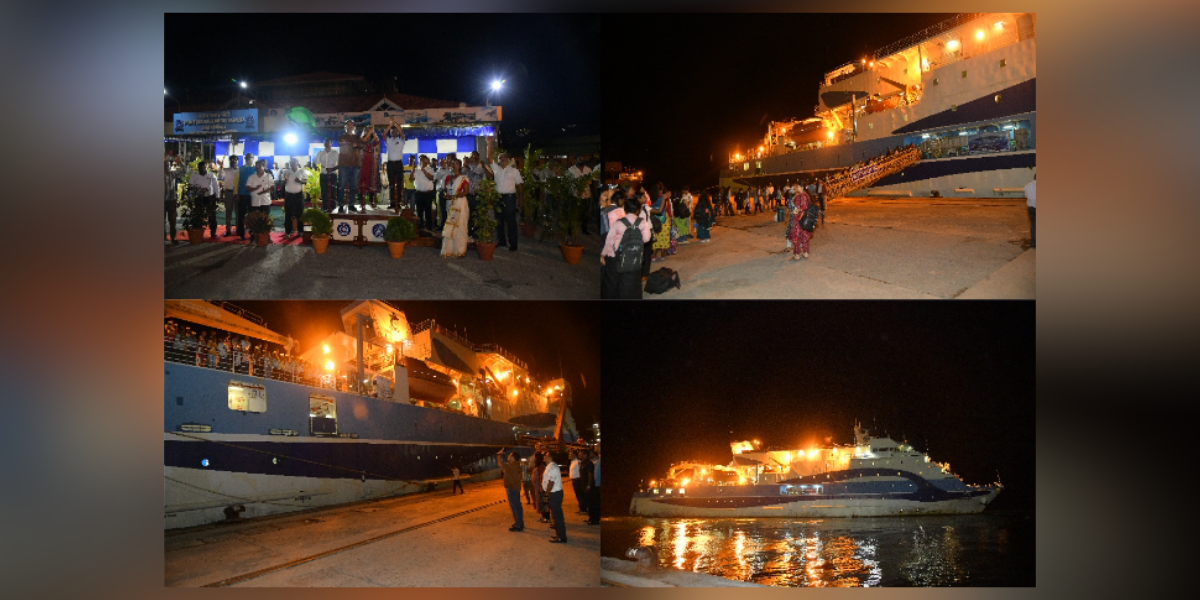
The serene night at Haddo Wharf turned into a moment of excitement and anticipation as the passenger vessel Sindhu set sail towards Barren Island, India’s only active volcano, marking a milestone in both education and tourism for the Andaman and Nicobar Islands. The Chief Secretary of the Administration flagged off the special cruise late in the evening, in the presence of senior officials, educators, and students, signalling the beginning of a new chapter in experiential learning and island tourism.
The voyage carried 439 passengers, among whom 125 were government school students selected under the Samagra Shiksha programme. For these students, the trip was not just an excursion but an educational journey designed to bridge the gap between classroom concepts and real-world understanding. Accompanied by 12 escort teachers and one coordinator, the group represented six educational blocks: South Andaman, Wimberlygunj, Little Andaman, Diglipur, Mayabunder, and Rangat. The uniform selection process ensured fair participation from across the Islands, giving students from remote regions a rare opportunity to witness a natural phenomenon few have seen.
The Sindhu, operated by the Directorate of Shipping Services (DSS) under the A&N Administration, was prepared for the unique voyage with all safety and logistical protocols in place. As it departed Haddo Wharf, lights glimmered across the port waters, and a sense of adventure filled the air. For the students, many of whom had only studied volcanoes through textbooks and illustrations, this journey promised to turn theory into experience.
Barren Island, located about 135 km northeast of Port Blair, is the only active volcano in the Indian subcontinent and one of the few in the world accessible by sea. Its rugged slopes, dark lava deposits, and surrounding marine ecosystem make it an extraordinary natural laboratory. The Administration and the Department of Education envisioned this visit as part of a broader effort to integrate experiential and place-based learning into the education system, in line with the National Education Policy (NEP) 2020.
Under the supervision of the State Project Office, Samagra Shiksha, every detail of the educational component was carefully planned. Students were briefed on the geology of the island, volcanic processes, and the importance of environmental conservation before boarding. The journey aimed to develop scientific curiosity, observation skills, and an appreciation for the Islands’ fragile ecosystem.
During the voyage, educators guided students in observing sea patterns, marine biodiversity, and volcanic formations. The sight of smoke rising faintly from the volcano’s crater left many awestruck, transforming textbook diagrams into vivid reality. For the students, it was more than a sightseeing trip — it was a rare encounter with Earth’s raw power and beauty.
After the tour, students are required to prepare individual reports documenting their observations and learning experiences. The best reports will be recognised and felicitated at a formal platform, while others will be encouraged to share their insights during school assemblies. This ensures that the knowledge gained extends beyond the participants, inspiring their peers across the Islands.
Officials highlighted that the Sindhu voyage symbolises a broader shift in how education is being redefined in the archipelago. The Chief Secretary observed that the successful organisation of such trips demonstrates the Administration’s commitment to combining learning with exploration. He noted that regular cruises to Barren Island could soon become a major attraction for tourists, offering them a rare chance to witness a living volcano in the middle of the Andaman Sea.
According to the Administration, there are plans to schedule two such trips every month, opening the experience not just to students but to travellers seeking unique natural adventures. This initiative is expected to boost local tourism and provide a sustainable model for cruise-based exploration, while also strengthening the educational and scientific engagement of the island community.
The voyage also reflects the Administration’s broader goal of promoting the Andaman and Nicobar Islands as a hub of eco-tourism and scientific learning. With efforts underway to encourage private operators to invest in similar ventures, the region could soon see a new wave of interest from both domestic and international visitors eager to explore its natural wonders.
For the students aboard Sindhu, the experience may have been short, but the impact is likely to be lasting. Witnessing the Barren Island volcano firsthand not only deepened their understanding of earth sciences but also instilled a sense of responsibility towards preserving nature. As one teacher remarked during the briefing, the visit was designed to nurture “thinking students, not just studying students.”The Barren Island cruise, therefore, stood at the crossroads of education and tourism, transforming a geography lesson into an unforgettable journey of discovery. As the Sindhu returned to Port Blair under a starlit sky, it carried back not just passengers but young minds brimming with curiosity and wonder, a testament to the power of experiential learning and the limitless potential of the Andaman seas.