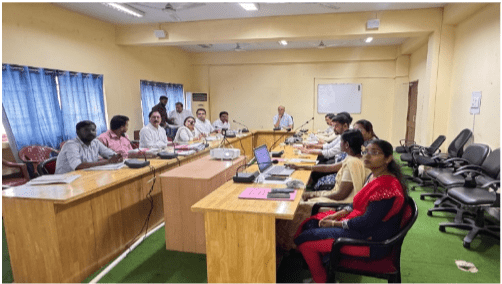
The 31st meeting of the Andaman & Nicobar Islands Building and Other Construction Workers Welfare Board packed a punch of pragmatism into bureaucratic ritual when members converged in the Labour Commissioner’s conference hall on 30 May. By session’s end, the board green-lit Rs 8.14 lakh in assistance across 53 worker claims, demonstrating how administrative signatures translate into textbook social-security wins.
Chairperson and Labour Secretary L Kumar set the tenor early, reminding attendees that welfare policy rings hollow unless claim cheques clear bank accounts on time. Construction remains one of the archipelago’s fastest-growing industries, fuelled by tourism corridors and military infrastructure, yet its labour force grapples with job-site hazards and irregular pensions. The board, constituted in 2009 and now stewarding nine schemes, acts as a financial shock-absorber against those risks.
Agenda papers listed requests for pension top-ups, education grants, maternity aid and death compensation. Over two hours, members representing employers and trade unions cross-checked affidavits, hospital summaries and school-fee receipts before unanimous approval. The decision triggers Direct Benefit Transfer workflows expected to credit accounts within a fortnight.
Kumar pivoted the discussion toward outreach gaps. Many masons and scaffolders on micro-projects remain unregistered, he warned, leaving social protection on the table. The board resolved to deploy digital megaphones: WhatsApp explainers in Hindi, Bengali and Nicobari; QR codes at cement depots linking to enrolment forms; and site-level poster drives carried by labour inspectors during routine safety audits.
A pilot will trial biometric enrolment kiosks at large construction sites, allowing workers to register in minutes rather than queue at district offices on wage-less days. Board members argued this could double active membership within a year, expanding the fund’s contribution base and enabling richer benefits.
Employers’ representatives highlighted pain-points too: often, worksite managers struggle to track which daily wagers qualify, leading to inadvertent non-compliance fines. The board promised a cloud dashboard mapping site rosters to welfare IDs in real time, reducing paperwork friction.
Financial sustainability surfaced next. The welfare corpus, fed by a cess pegged at one percent of project costs, remains healthy, but rising education-grant demand could nudge outflows north. Actuaries will model scenarios for incremental cess tweaks or tiered aid caps. However, members agreed that any adjustment must not spook small contractors already squeezed by material inflation.
Beyond spreadsheets, anecdotes reminded delegates of human stakes. A widow’s timely death-benefit payout kept her children in school; a mason’s maternity grant covered hospital bills when an emergency C-section loomed. Such cases, Kumar noted, become the welfare board’s living testimonials, incentivising peer enrolment more effectively than pamphlets.
The meeting closed with a mandate to audit scheme delivery end-to-end. A third-party assessment will sample beneficiaries, verifying whether DBT credits translate into intended usage, school fees paid, pensioners receiving tablets, maternity recipients covering postpartum nutrition. Transparency, members hope, builds the credibility needed to convince the archipelago’s transient workforce that bureaucracy can indeed bend toward their wellbeing.
As attendees dispersed, hard hats still perched on some union delegates’ laps, the welfare board’s challenge crystallised: align a labour force often on the move with a benefits ledger anchored in offices. If digital bridges narrow that distance, next year’s claims may spike beyond 53, but so will the safety net’s stretch, proving social security scalable amid island scaffolds and skylines.