Agriculture in the Andaman and Nicobar Islands is under sharp focus this week as the administration rolled out dual initiatives that highlight both crisis management and long-term resilience. On one hand, officials are responding to reports of pest infestation in plantation crops in Little Andaman, while on the other, the Department of Agriculture commemorated Antyodaya Diwas with a plantation drive aimed at sustainable spice cultivation.
The administration has deputed a six-member committee to Little Andaman following reports of severe pest damage threatening plantations. The team includes senior officials alongside experts from ICAR-Central Island Agricultural Research Institute and the Central Integrated Pest Management Centre. Their mandate is to conduct a ground-level assessment, consult with farmers and Panchayati Raj representatives, and recommend immediate remedial measures.
The urgency of the visit underscores the importance of plantation crops as a backbone of local livelihoods. Officials have indicated that scientific and timely interventions will be prioritized to contain the infestation before it spreads further. To strengthen the response, the administration has also proposed calling in a specialized team from the Ministry of Agriculture and Farmers’ Welfare. Such expertise is expected to provide advanced strategies for integrated pest management suited to island ecosystems.

This proactive intervention reflects what the administration has described as a “farmer-first approach,” with emphasis on securing incomes and sustaining crop productivity in the face of emerging threats. Farmers, many of whom depend on plantations for both livelihood and food security, have been assured that their concerns are being treated with urgency.
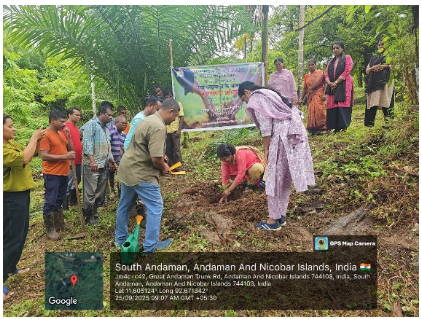
While pest management dominated the headlines in Little Andaman, the Department of Agriculture marked Antyodaya Diwas across the islands with activities focused on sustainability and grassroots empowerment. Celebrated annually on the birth anniversary of Pandit Deendayal Upadhyaya, the day reflects a vision of inclusive development. Under the ongoing Sewa Pakhwada campaign, officials, farmers, and stakeholders gathered at the Organic Horticulture Farm in Sippighat for a plantation drive themed “Ek Ped Maa Ke Naam.”
Nutmeg seedlings were planted by officials to mark the occasion, while progressive farmers contributed by planting black pepper vines. The emphasis on spices highlights a strategy to diversify and strengthen local agriculture, moving beyond staple crops to include high-value commodities. The initiative not only supports biodiversity but also opens opportunities for farmers to tap into niche markets where organically grown spices command premium prices.
The plantation activity also symbolized the alignment of environmental conservation with economic resilience. By integrating ecological action with farming practices, the department seeks to reduce vulnerability to external shocks and promote a more sustainable agricultural model across the islands. The fact that the initiative is being carried forward across all zones reflects broad-based commitment from farming communities.
For many farmers, such drives are a reminder of the importance of long-term resilience in agriculture. Pest infestations, unpredictable weather, and logistical challenges often complicate farming in island environments. By pairing emergency response measures with ecological initiatives like spice plantations, the administration is attempting to balance immediate relief with structural transformation.

Officials emphasized that the plantation drive is not just symbolic but part of a sustained push to align agriculture with the ideals of self-reliance and inclusivity. The participation of farmers alongside officials demonstrated the cooperative spirit envisioned by Deendayal Upadhyaya’s philosophy of Integral Humanism, where development is measured not just in economic gains but in social and environmental wellbeing.
Together, the twin developments, the pest control mission and the Antyodaya Diwas plantation drive, capture the challenges and aspirations of the agricultural sector in Andaman and Nicobar. They show an administration responding quickly to crises while also keeping an eye on the future of farming in the islands.