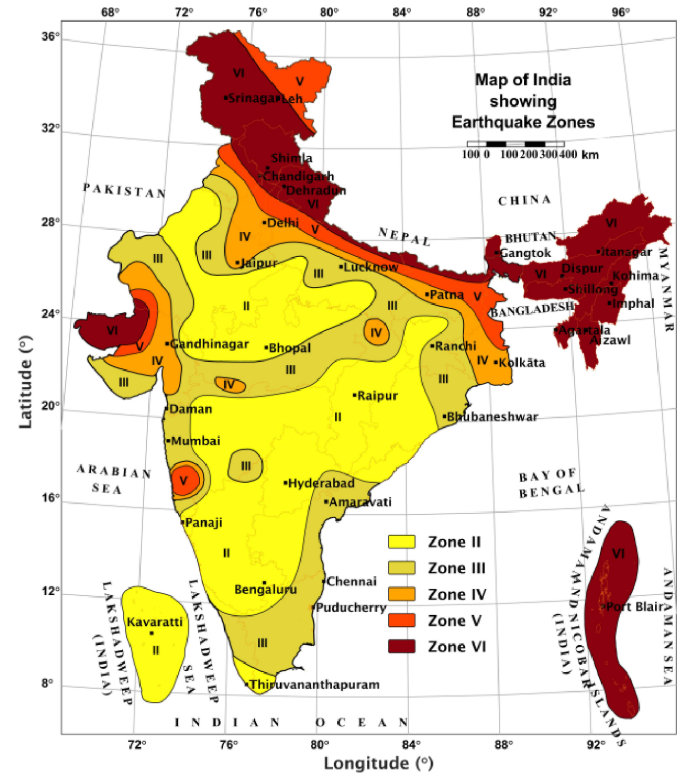
The Andaman and Nicobar Islands have been placed in the highest seismic risk category under India’s newly revised earthquake zonation map, marking a significant shift in how earthquake hazards in the island territory are officially recognised and planned for. The updated map, released under the 2025 Earthquake Design Code, shows almost the entire archipelago, including Sri Vijaya Puram, falling under the newly introduced Zone VI, the most hazardous category on the national seismic scale.
The revised seismic map now classifies India into zones ranging from Zone II, which represents the lowest earthquake risk, to Zone VI, which denotes the highest hazard level. Earlier, Zone V was considered the most severe category and included regions such as the Northeast, the Kashmir belt, the Rann of Kutch and the Andaman and Nicobar Islands. The introduction of Zone VI places areas with the most intense seismic potential into a separate and more stringent category, reflecting evolving scientific understanding of earthquake behaviour and ground motion.
For the Andaman and Nicobar Islands, the classification into Zone VI reflects their unique and vulnerable tectonic setting. The islands lie along the active Andaman–Sumatra subduction zone, where the Indian tectonic plate is continuously moving beneath the Burma microplate. This ongoing plate convergence leads to the build-up of stress that is released through powerful, shallow earthquakes, often accompanied by vertical movement of the seabed. The devastating 2004 Indian Ocean earthquake and tsunami originated from this same tectonic system.
In addition to the main subduction zone, the islands are affected by several complex fault systems, including the West Andaman Fault and multiple offshore faults running along a long north–south stretch. These geological features increase the likelihood of strong and widespread ground shaking during major seismic events. Soft coastal sediments and reclaimed land around certain settlements further amplify shaking, raising localised risk even within the limited land area of the islands.
The placement of the islands in Zone VI has direct implications for construction, infrastructure planning and disaster preparedness. Buildings and infrastructure are now expected to be designed using the strictest earthquake-resistant standards prescribed in Indian codes. Design forces will be higher than those earlier applied under Zone V, requiring stronger structural systems, improved foundations and more robust connections to withstand severe shaking.
Critical infrastructure such as hospitals, ports, airports, bridges, communication towers and lifeline roads will require special engineering provisions to ensure they remain functional after major earthquakes. These facilities are expected to be designed with higher importance factors, meaning they must withstand stronger seismic forces than ordinary buildings.
The revised classification also carries implications for land-use planning in the islands. Avoiding dense settlements and critical facilities near unstable slopes, reclaimed coastlines and known fault traces becomes increasingly important. Regular assessment and retrofitting of older buildings, many of which were constructed before modern seismic codes were enforced, is expected to gain urgency.
Authorities and disaster management planners have emphasised that preparedness in the islands must go beyond structural design. Given the proximity of the islands to offshore earthquake sources, tsunami risks with short warning times remain a critical concern. Early warning systems, clearly marked evacuation routes and safe zones on higher ground, along with regular community drills for earthquakes and tsunamis, are essential components of disaster risk reduction in the territory.
The inclusion of the Andaman and Nicobar Islands in the highest seismic risk zone underscores the need for stricter enforcement of building regulations, improved planning practices and sustained public awareness. As scientific mapping continues to refine India’s understanding of earthquake hazards, the updated zonation serves as a reminder of the unique vulnerability of the islands and the importance of preparedness in a highly active seismic region.