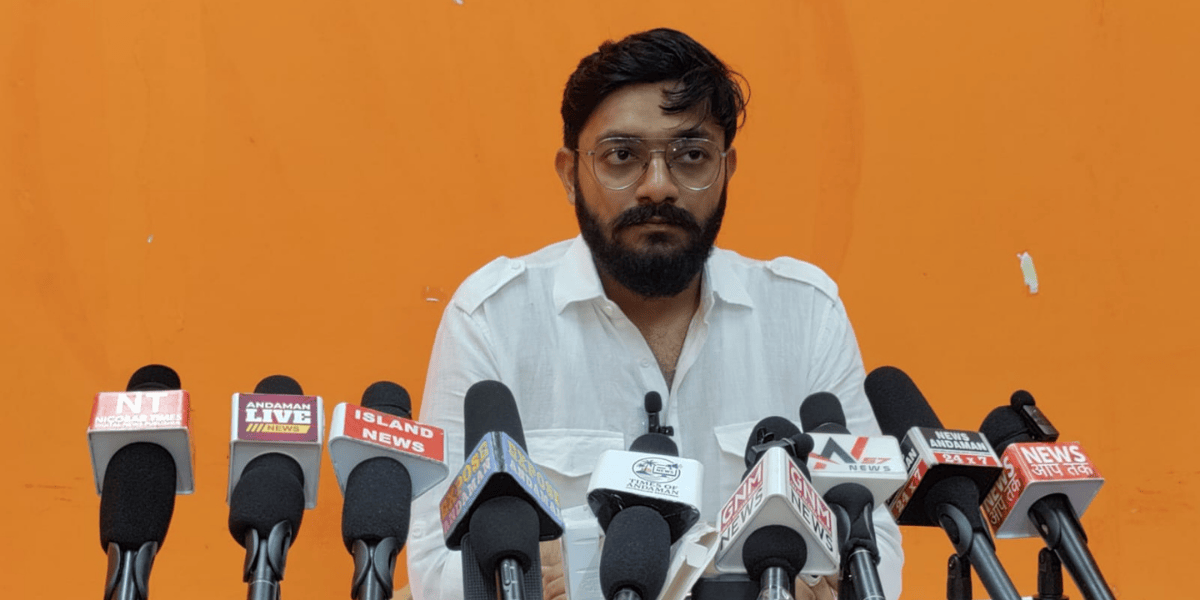
In a press conference held on February 12 regarding the proposed Netaji Subhash Chandra Bose Institute of Higher Learning as a deemed-to-be university in the Andaman and Nicobar Islands, a youth leader outlined serious legal, academic, and administrative concerns. The announcement, which follows years of discussion dating back to Prime Minister Narendra Modi’s 2018 visit, has sparked debate among students, parents, and political representatives over the legitimacy and impact of the transition.
Siddhant Rai Sharma, a former member of the Akhil Bharatiya Vidyarthi Parishad (ABVP), detailed the timeline of events, noting that despite repeated demands from student organizations for a fully autonomous Central University and assurances from Home Minister Amit Shah and President Droupadi Murmu, the local administration formally applied for deemed status with the University Grants Commission (UGC) on January 20, 2023. Sharma described the move as a “deemed democracy,” where bureaucratic decisions override the will of the people and elected representatives.

He highlighted multiple administrative and legal discrepancies that disqualify the proposed institute from deemed university status under UGC regulations. Faculty research output is insufficient, with many failing to meet the requirement of at least two publications per year in recognized journals. Infrastructure deficiencies also pose a major concern, with UGC norms mandating 30 square meters of built-up area per student, a standard that cannot be met even by combining all proposed sites. Postgraduate courses in critical subjects such as Zoology and Botany are absent, despite the islands’ rich natural resources and existing research centers like the Zoological Survey of India (ZSI) and Botanical Survey of India (BSI).
Sharma raised the plight of students currently affiliated with Pondicherry University. Delays in convocations during the COVID-19 pandemic have left many graduates without official degrees, requiring costly mainland travel to obtain credentials. He warned that severing Pondicherry University affiliation without a clear framework would create an administrative vacuum. He criticized the deemed university push as an “escapist strategy” that avoids addressing long-standing affiliation issues at institutions like DBRAIT and Andaman Law College.
The leadership of the proposed university was also questioned, with Sharma noting that the newly appointed Vice-Chancellor, based in Kolkata, has not engaged directly with students on the islands. Even local Member of Parliament Bishnu Pada Ray has petitioned the Prime Minister and Lieutenant Governor to suspend the proposal, but the administration continues its efforts.

Sharma concluded by calling for accountability and unity among island residents, warning that if transparency regarding funding, fees, and autonomy is not provided, youth and political organizations will form a “Joint Action Forum” to escalate protests.
The situation underscores tensions between administrative ambitions and the academic, infrastructural, and governance realities of higher education in the Andaman and Nicobar Islands, with student welfare and institutional legitimacy at the center of the debate.