The Andaman and Nicobar Islands are being positioned as a key hub in India’s Blue Economy strategy, with the Centre intensifying efforts to harness marine resources for economic growth, employment generation and environmental sustainability.
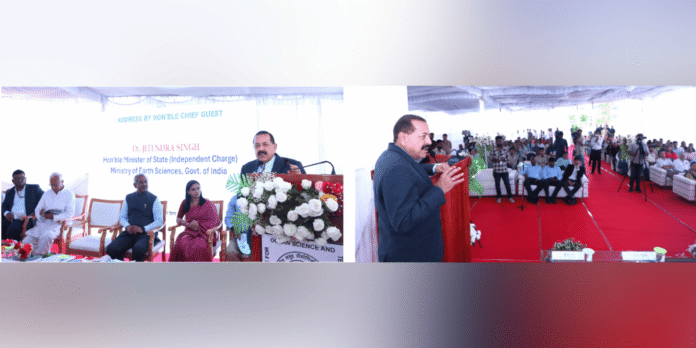
Union Minister of State (Independent Charge) for Science and Technology and Earth Sciences, Jitendra Singh, said this during his visit to the Atal Centre for Ocean Science and Technology for Islands (ACOSTI) at Dollygunj in Sri Vijaya Puram, where he launched and reviewed a series of marine technology initiatives aimed at strengthening livelihoods and boosting the island economy.
Addressing scientists, officials and local stakeholders, the Minister said India’s future economic value addition would increasingly come from underutilised marine resources as the country advances towards becoming one of the world’s leading economies. He underlined that the Government’s focus on the Blue Economy reflects a policy approach that does not confine development to the mainland, but extends equal priority to island territories and coastal regions.

The programme, organised at ACOSTI, a unit of the National Institute of Ocean Technology under the Ministry of Earth Sciences, was attended by the Member of Parliament from Andaman and Nicobar Islands, the Secretary of the Ministry of Earth Sciences, senior officials of the Andaman and Nicobar Administration, scientists from NIOT and other research institutions, as well as representatives of local departments and Self-Help Groups.
Referring to the Deep Ocean Mission, the Minister said the repeated announcements of the mission by the Prime Minister from the Red Fort reflected the national priority accorded to marine resources. He observed that as conventional resources face increasing pressure, marine resources would play a decisive role in sustaining India’s long-term growth, contributing to employment, exports and economic resilience while supporting environmental goals.
During the visit, several pilot initiatives were launched and demonstrated, including open sea cage culture of marine fish and large-scale seaweed cultivation. The Minister noted that technology transfer to the field level had already taken place, indicating progress towards translating research into livelihoods. He emphasised that the unique marine biodiversity and coastal characteristics of the Andaman and Nicobar Islands make the region particularly suitable for such projects.
The Minister also highlighted the integration of ocean sciences with biotechnology as a strategic priority. He pointed out that India is among the few countries with a dedicated biotechnology policy, BioE3, which focuses on the economy, environment and employment. According to him, marine bio-resources offer scope for developing biodegradable alternatives to plastics, new medicinal compounds and high-value bio-products, creating opportunities for both innovation and job creation.

Emerging areas such as alternative marine-based nutrition, non-animal food products, waste-to-wealth technologies and export-oriented marine produce were also identified as growth segments with rising international demand, particularly in European markets. The Minister stressed that greater participation of Self-Help Groups and women would be essential to ensure that these initiatives supplement household incomes and strengthen local entrepreneurship.
He further stated that consistent representation of island issues at the national level has helped direct attention and resources towards island development, and noted that since 2014, increased scientific and administrative engagement in the region has become visible through multiple national initiatives.
Concluding his visit, the Minister expressed confidence that with institutional collaboration, including potential involvement of CSIR and biotechnology research centres, the Andaman and Nicobar Islands could emerge as a major centre for India’s Blue Economy. He reaffirmed the Government’s commitment to sustained engagement with the region, stating that the initiatives underway are expected to deliver long-term scientific, environmental and socio-economic benefits.



