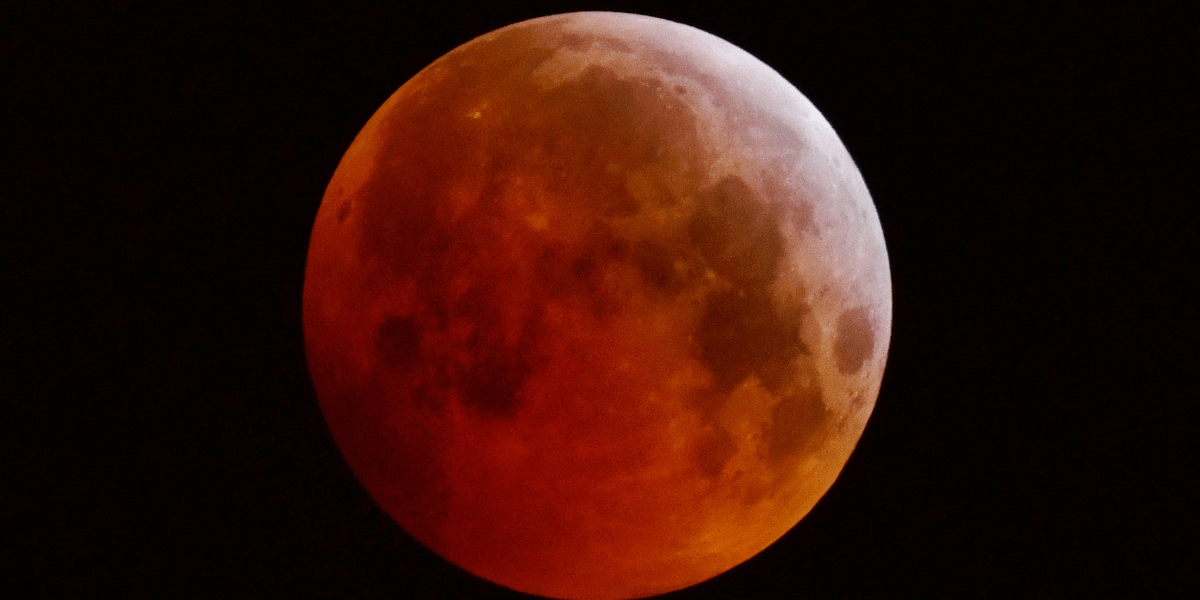
A rare celestial spectacle is set to unfold in the skies over the Andaman and Nicobar Islands on the night of September 7-8, when a total lunar eclipse, popularly known as a “Blood Moon”, will be visible across the archipelago and the rest of India. The eclipse, lasting more than five hours from start to finish, promises one of nature’s most dramatic shows for skywatchers, students, and astronomy enthusiasts.
Astronomical charts indicate that the penumbral phase will begin at 8:58 p.m. on September 7, progressing into the partial eclipse at 9:57 p.m. The total eclipse will commence at 11:00 p.m., reaching its peak at 11:41 p.m. before ending at 12:22 a.m. on September 8. The partial and penumbral phases will then gradually taper off, concluding at 2:25 a.m. These stages will be visible across India, offering residents a chance to observe the changing hues of the Moon throughout the night.
The phenomenon occurs when the Earth passes directly between the Sun and the Moon, casting its shadow over the lunar surface. During this alignment, the Moon does not disappear but instead takes on a crimson glow, caused by sunlight filtering through the Earth’s atmosphere and scattering shorter blue wavelengths while letting red tones reach the Moon. This transformation into a so-called Blood Moon has long fascinated cultures worldwide and continues to captivate both amateur and professional astronomers.
In anticipation of heightened interest, the Science Centre at Sri Vijaya Puram has announced a special public programme on September 7. Beginning at 9:30 p.m. and continuing until 12:30 a.m., the event will feature a multimedia presentation explaining the science of eclipses, followed by live viewing sessions through a high-powered telescope. Officials said the programme aims to spark curiosity among students while encouraging the wider public to experience the eclipse as a community event.
The viewing is dependent on weather conditions, with cloud cover and September showers posing a possible challenge. Nevertheless, the Science Centre will go ahead with its presentations even if the sky does not clear, ensuring attendees gain insights into the phenomenon.
Total lunar eclipses, though more common than solar eclipses, remain rare enough to be highly anticipated. Unlike solar events, they are completely safe to view with the naked eye and do not require special equipment. The extended duration also means that observers can follow the eclipse at different stages, from the gradual encroachment of Earth’s shadow to the peak crimson phase and the eventual restoration of the Moon’s brightness.
For the Andaman and Nicobar Islands, where educational resources can be limited due to geography, public programmes of this nature are seen as especially valuable. Families, tourists, and science enthusiasts will be able to gather and share the experience, turning the night sky into a classroom of its own. Officials noted that such events help foster a deeper understanding of science and strengthen appreciation for the fragile balance of the natural world.
Globally, lunar eclipses continue to inspire not only scientific curiosity but also cultural traditions, often viewed as omens or symbolic moments. In modern times, however, they are recognised as opportunities to witness the mechanics of celestial bodies in motion. The September 7-8 eclipse is expected to attract widespread attention across India, with the Moon’s transformation into a glowing red orb promising a memorable night.For more details on the stages of the eclipse and its visibility across India and the islands, readers can explore this detailed report: Total Lunar Eclipse to Be Seen Across India and Andaman & Nicobar Islands on Sept 7-8.