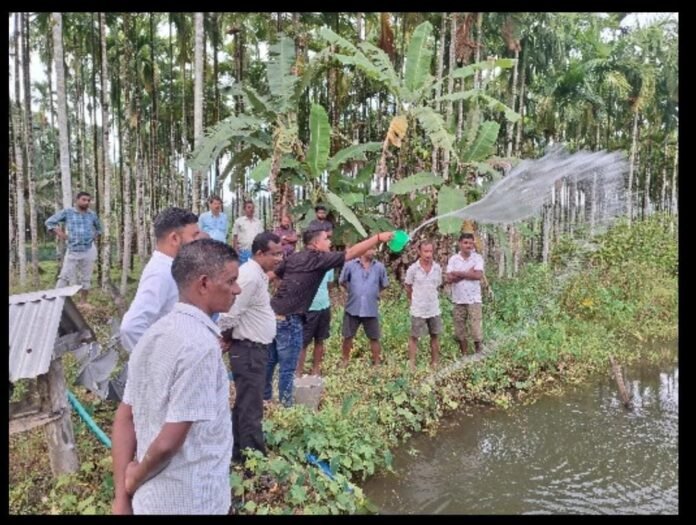
Sri Vijaya Puram, November 4: Farmers across the Andaman and Nicobar Islands can avail financial assistance for developing irrigation facilities on their agricultural land, with the Department of Agriculture offering subsidies for pond excavation, construction of wells, purchase of pumpsets and installation of micro irrigation systems under its Development of Minor Irrigation scheme.
Implemented under the Union Territory Plan, the scheme aims to strengthen irrigation infrastructure and support individual farmers as well as cooperative farming societies. The assistance is being extended through three patterns: loan-cum-subsidy, Shramdan-cum-subsidy and cash-cum-subsidy. Under the loan-cum-subsidy arrangement, beneficiaries can obtain their share of the project cost as a loan from a nationalised bank.
The scheme provides financial support for four major components, with the level of assistance varying according to the nature of the irrigation facility and eligibility criteria.
Pond Excavation
For excavation of ponds, bonafide individual farmers possessing a minimum of 0.50 hectare of cultivable land and cooperative farming societies are eligible for assistance amounting to 50 per cent of the estimated cost, subject to a maximum subsidy of Rs. 1.50 lakh per pond.
The provision is intended to help farmers create water storage facilities that can support cultivation, particularly when rainfall is inadequate or irrigation requirements extend beyond the monsoon season.
Well Construction
Farmers can also receive financial assistance for constructing reinforced cement concrete (RCC) ring wells. Under this component, bonafide individual farmers are eligible irrespective of their landholding size, while cooperative farming societies can also apply.
The subsidy covers 50 per cent of the estimated construction cost, subject to a ceiling of Rs. 1 lakh per well.
Pumpset Purchase
To improve access to water for agricultural operations, the department is extending assistance for purchasing pumpsets ranging from 0.5 HP to 5 HP.
Individual farmers and cooperative farming societies can avail this benefit irrespective of the size of their landholding. The subsidy will cover 50 per cent of the purchase cost or a maximum of Rs. 10,000 per pumpset, whichever is lower.
Drip Irrigation
The highest subsidy under the scheme is available for installing micro irrigation systems, including drip and sprinkler irrigation.
Bonafide individual farmers with a minimum of 0.05 hectare of cultivable land and cooperative farming societies are eligible for assistance covering 75 per cent of the system cost, including the pumpset, or Rs. 93,750 per hectare, whichever is lower. The department will also provide 100 per cent transport subsidy for this component.
Micro irrigation systems are designed to deliver water more efficiently to crops, helping farmers manage available water resources while reducing wastage. Such systems can be particularly useful for agricultural holdings where conventional irrigation methods may be difficult or expensive to maintain.
How to Apply
Interested farmers have been advised to approach the zonal office of the Agriculture Department in their respective areas to obtain the prescribed application form.
The completed application must be submitted to the concerned zonal office along with the required documents, including the duly filled application form, the latest land record obtained from a Common Service Centre (CSC), either in original or attested by a Gazetted Officer or Revenue Officer, a copy of the Aadhaar card and bank account details issued in the farmer’s name.
The scheme offers support across different stages of irrigation development, from creating water storage facilities to installing systems for efficient water distribution. Farmers interested in strengthening irrigation on their holdings can contact their respective zonal offices for application forms and further details on the assistance available.
By extending financial support for both conventional and micro irrigation infrastructure, the department aims to encourage greater investment in farm-level water management and strengthen the irrigation capacity of agricultural holdings across the islands.