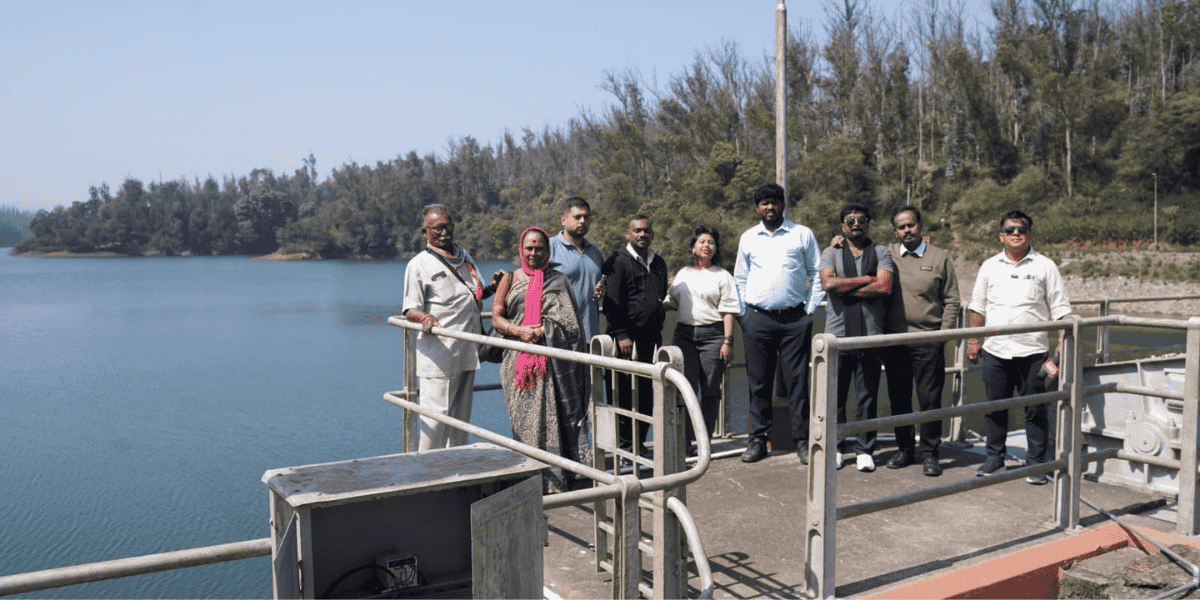
Journalists from the Andaman and Nicobar Islands visited hydroelectric power facilities operated by Tamil Nadu Green Energy Corporation Limited in the Kundah region of the Nilgiris district as part of a media exposure programme organised by the Press Information Bureau, aimed at understanding renewable electricity generation and its relevance for island territories.
During the visit, the media team interacted with engineering officials who explained the operation of the Pykara and Kundah Hydro Electric Schemes, two major hydropower generation systems that contribute significantly to Tamil Nadu’s electricity supply. The interaction provided an overview of the functioning of the plants, their historical background and the engineering systems used for power generation.
Engineers informed the visiting journalists that the Pykara Hydro Electric Scheme was initiated in 1929 by the then Government of Madras with technical support from the London Power Corporation. The project was among the earliest hydroelectric developments in India and utilises water from the Pykara River, which drains a large portion of the Nilgiris plateau and receives average annual rainfall exceeding 2000 millimetres.

Officials explained that the hydro generation network currently operates around 12 power houses arranged in a cascade system. Water from the Pykara Dam and nearby reservoirs is channelled through tunnels and penstocks before reaching turbines installed at power stations located at lower elevations. Electricity is generated as the high-pressure water drives the turbines connected to generators.
According to engineers, the hydroelectric plants operate at maximum capacity during the monsoon season, generally from June to early August, when water levels are high. During this period, the generation network is capable of producing up to 700 megawatts of electricity across the hydroelectric facilities.
The Pykara Mini Micro Power House, commissioned in 1989, contributes around two megawatts of electricity to the grid, while the remaining units within the complex collectively add significant power generation capacity to the state’s energy system.
Officials also highlighted the engineering characteristics of the Pykara hydro system, noting that it operates under extremely high hydraulic pressure reaching nearly 110 bar. During the early decades of operation in the 1930s, this level of hydraulic pressure was considered among the highest for hydroelectric plants in Asia. The system utilises a water head exceeding 1,000 metres, allowing efficient power generation through gravitational flow.
The catchment area feeding the Pykara hydro system extends across approximately 77.88 square kilometres, forming an important water resource in the Nilgiris region. Engineers explained that the hydroelectric facilities also incorporate a pumping mechanism that allows water discharged at lower levels to be pumped back to upper reservoirs. This recycling system allows water to be reused for additional power generation cycles and helps reduce operational costs by maximising natural water flow.
The visiting journalists were also briefed on the Kundah Hydro Electric Scheme, one of the largest hydropower projects in Tamil Nadu with an installed capacity of 585 megawatts. The project utilises water from the Upper Bhavani River and surrounding catchment areas.
Reservoirs including Upper Bhavani, Avalanche, Emerald, Porthimund and Parsons Valley supply water to the power generation network, which operates through a cascade system across multiple hydroelectric stations. Electricity generated from these plants is transmitted through 110 kilovolt and 230 kilovolt transmission lines to substations located at Thudialur, Arasur, Sandynallah and Karamadai.

Officials explained that the hydroelectric installations also function as training facilities where engineering students, academic institutions and technical professionals receive exposure to hydropower systems and electricity generation technologies.
Although the projects are designed primarily for power generation, officials noted that water stored in the reservoirs also supports limited irrigation needs and provides drinking water to nearby panchayat areas.
The exposure visit offered journalists a detailed understanding of large-scale hydropower systems and renewable energy infrastructure, providing insights into sustainable electricity generation models that may hold relevance for long-term energy planning in the Andaman and Nicobar Islands.Journalists from Andaman Islands Explore Hydropower Projects in Nilgiris