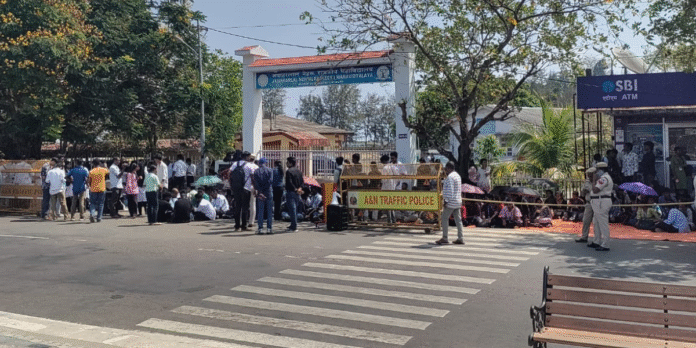
The debate over the proposed transition of higher education institutions in the Andaman and Nicobar Islands from central university affiliation to deemed university status has intensified in recent weeks. What should have been a measured academic discussion is increasingly being framed through emotional appeals, political rhetoric and selective information.
This editorial takes a clear view: students must not allow their academic future to be shaped by political propaganda.
Dear students, you have every right to question policy. You have every right to seek clarity on fees, governance structures, degree recognition and academic freedom. But you must be careful not to confuse legitimate concern with narratives designed to inflame.
Whenever institutional reform is proposed, political interest groups step in. Some may genuinely believe they are protecting student interests. Others may see an opportunity to mobilise sentiment for unrelated political objectives. In such moments, fear becomes a powerful tool. Dramatic language spreads faster than regulatory detail. Outrage circulates more easily than facts.

You must ask yourselves: who gains if anxiety spreads? Who benefits if students react before understanding the full framework?
Under the University Grants Commission framework, deemed universities are legally recognised institutions. Degrees awarded under such a structure remain valid across India. The governance model may change, but legal recognition does not vanish. Suggesting otherwise without evidence is misleading.
At the same time, your concerns are not irrational. Institutional reputation takes time to build. Students currently enrolled may feel uneasy about graduating under a different structure than the one they expected. These are real issues that deserve structured answers.
But structured answers require structured engagement, not slogans, not viral forwards, not street-level dramatics driven by political messaging.
The Wave Andaman’s opinion is that students must remain vigilant, but not volatile.
If you are worried about fee escalation, demand written assurances. If you are concerned about academic freedom, insist on formal safeguards. If you seek clarity on leadership appointments, ask for a published framework. These are mature, responsible responses.
What you must avoid is being swept up by narratives that simplify a complex policy change into a battle between “good” and “bad.” Educational reform is rarely that binary. It is a matter of governance design, implementation quality and accountability.
The administration, for its part, must recognise that silence fuels suspicion. If misinformation is circulating, it must be countered with transparent documentation. A detailed white paper outlining the transition roadmap, governance structure, Vice Chancellor appointment process, financial model and student protection mechanisms would help restore confidence.
But while the administration must communicate better, students must think independently.
Withdrawing mid-course, escalating confrontation without verified facts, or allowing political slogans to dictate academic decisions could carry consequences that extend far beyond the current moment. Political groups may move on. Your academic record and career trajectory will not.

Educational autonomy is not inherently a threat. In fact, for the Andaman and Nicobar Islands, greater flexibility could allow development of specialised programmes in marine sciences, climate resilience and sustainable island development, areas uniquely relevant to the region. The outcome depends not on the label alone, but on governance integrity.
Dear students, your strength lies in informed reasoning, not reactive mobilisation.
Dear administration, your credibility lies in transparency, not authority alone.
Do not let propaganda define your understanding. Do not let vested interests determine your response. Demand clarity, examine documents, question firmly, but think critically.
Your academic future deserves judgment guided by facts, not fear manufactured for political advantage.