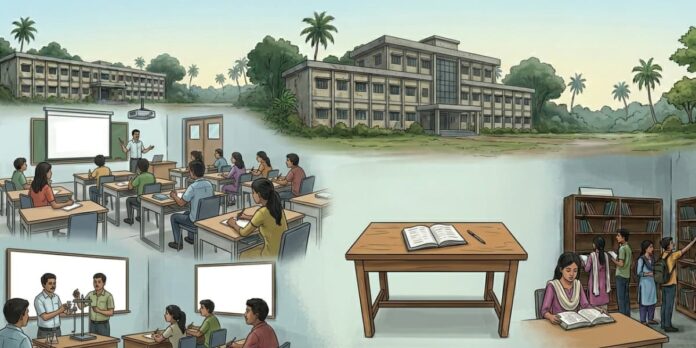
Concerns over severe faculty shortages and inadequate infrastructure in higher education institutions in the Andaman and Nicobar Islands have been raised with the Ministry of Education, with a call for immediate central intervention to address the situation.
Member of Parliament Bishnu Pada Ray has written to the Secretary of the Ministry of Education, highlighting what he described as poor management and a critical lack of regular teaching staff across colleges in the islands. The communication follows visits to seven colleges, where deficiencies in staffing and academic facilities were observed.
According to the letter, several institutions are operating without the required number of full-time Professors, Associate Professors and Assistant Professors. In place of permanent faculty, colleges are relying heavily on guest lecturers engaged on fixed lump-sum payments. The arrangement, the MP stated, is affecting the quality of higher education and limiting consistent academic delivery.

The issue has been attributed to delays in filling sanctioned posts. Data shared in the communication indicates significant gaps between approved and existing faculty strength. At Jawaharlal Nehru Rajkeeya Mahavidyalaya, against a sanctioned strength of 85, only 56 positions are filled, with 33 vacancies and 115 guest faculty engagements. Andaman College shows 16 sanctioned posts with only two filled and a large dependence on guest faculty numbering 45.
In the B.Ed college, 33 posts are sanctioned, with nine filled and 24 vacant, supported by 50 guest faculty. Dr B R Ambedkar Institute of Technology reports 62 sanctioned posts, 42 filled positions and 20 vacancies, with limited reliance on guest faculty. The law college, established in 2015, continues to operate without a full-time principal or regular professors and is currently managed by a contractual principal and guest faculty.
Beyond staffing gaps, the MP pointed to the absence of essential academic and practical facilities required under prescribed standards. The lack of adequate infrastructure, including laboratory and teaching resources, has affected the quality of instruction and limited students’ access to necessary practical exposure.
The overall management of colleges has been described as unsatisfactory, with systemic issues affecting both academic delivery and institutional functioning. The MP has urged the Ministry to direct the Union Territory administration to prioritise the filling of all vacant teaching positions.

The letter also calls for the deployment of an expert team from the Ministry of Education or the University Grants Commission to conduct a comprehensive inspection of all colleges in the islands. The proposed assessment would examine whether institutions meet required norms for infrastructure, faculty strength and academic standards.
It has been suggested that consultations with Panchayati Raj Institutions, elected representatives and the student community be included as part of the inspection process to reflect ground-level realities.
The appeal seeks urgent action in what has been framed as a matter affecting the future of students and the overall quality of higher education in the Andaman and Nicobar Islands.