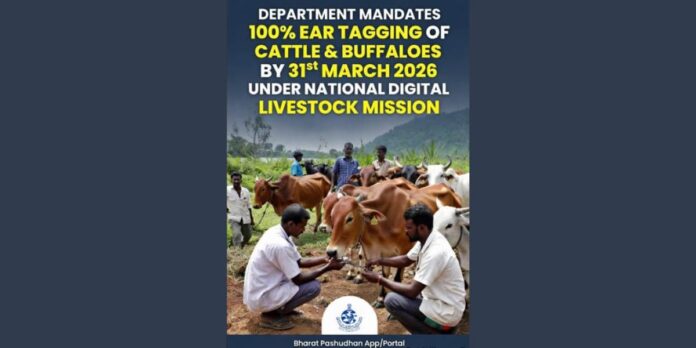
The Andaman and Nicobar Administration has made ear tagging of all cattle and buffaloes compulsory across the islands, setting a March 31, 2026 deadline as part of a nationwide push to digitise livestock data under the National Digital Livestock Mission.
The directive, issued by the Department of Animal Husbandry and Veterinary Services, requires complete coverage of livestock through unique identification linked to the Bharat Pashudhan App and portal. The move aims to establish a real-time digital database of animals and their owners in the Union Territory, enabling systematic tracking and management.
Authorities have positioned the measure as a structural shift in livestock governance. Each ear tag will serve as a unique identifier, allowing traceability of animals and strengthening systems for health monitoring, disease surveillance and control. The database is also expected to support breeding services, genetic improvement programmes and accurate record-keeping for vaccinations, treatments and access to government schemes.

The administration has made compliance a precondition for accessing veterinary services. From April 1, 2026, animals without valid ear tags linked to the NDLM platform will not be eligible for vaccinations, medical treatment, health certification or any other veterinary assistance. Officials have also suspended the issuance of Veterinary Health Certificates and Transportation Certificates for cattle and buffaloes until further orders. These documents will now be issued only after verification through the digital portal based on ear-tagged identification.
Livestock owners have been directed to maintain updated records on the portal, including details of animals that are sold, deceased or transferred. Authorities stated that accurate data entry is essential to ensure the effectiveness of the system and to maintain the integrity of livestock records across the islands.
Senior Veterinary Officers have been instructed to implement the tagging programme on priority and ensure full coverage within the stipulated timeframe. The department has initiated ground-level mobilisation, including setting up tagging facilities at veterinary institutions and dispensaries. Special camps and mobile tagging units will also be deployed to reach remote and rural areas, where access to fixed centres remains limited.

Officials have called on farmers and livestock owners to cooperate with the drive and complete tagging at the earliest. The administration has emphasised that timely compliance will be critical in avoiding disruptions to veterinary services once the mandate takes effect.
The initiative aligns with the Government of India’s broader objective of building a digitally integrated livestock sector. By linking identification, health records and service delivery to a centralised platform, the system is expected to improve productivity, streamline subsidy targeting and strengthen disease control mechanisms.
Authorities have maintained that the transition to a digital framework will support long-term sustainability in livestock management and enhance service delivery for communities dependent on animal husbandry in the Andaman and Nicobar Islands.