The Andaman basin is rapidly emerging as one of Asia’s most closely watched offshore energy frontiers. Long considered geologically promising but commercially uncertain, the basin is now witnessing renewed exploration activity across several countries bordering the Andaman Sea — notably India, Indonesia and Thailand. Fresh gas discoveries, new licensing rounds and rising regional energy demand are together reshaping the basin’s strategic importance.
Unlike many offshore energy regions, the Andaman basin is not confined to a single national jurisdiction. It forms part of a broader geological system stretching across the eastern Indian Ocean and linking waters off India’s Andaman and Nicobar Islands with offshore regions of Myanmar, Thailand and Indonesia. Because of this shared geological structure, discoveries or exploration developments in one part of the basin often increase interest across the wider region.

Indonesian discovery momentum
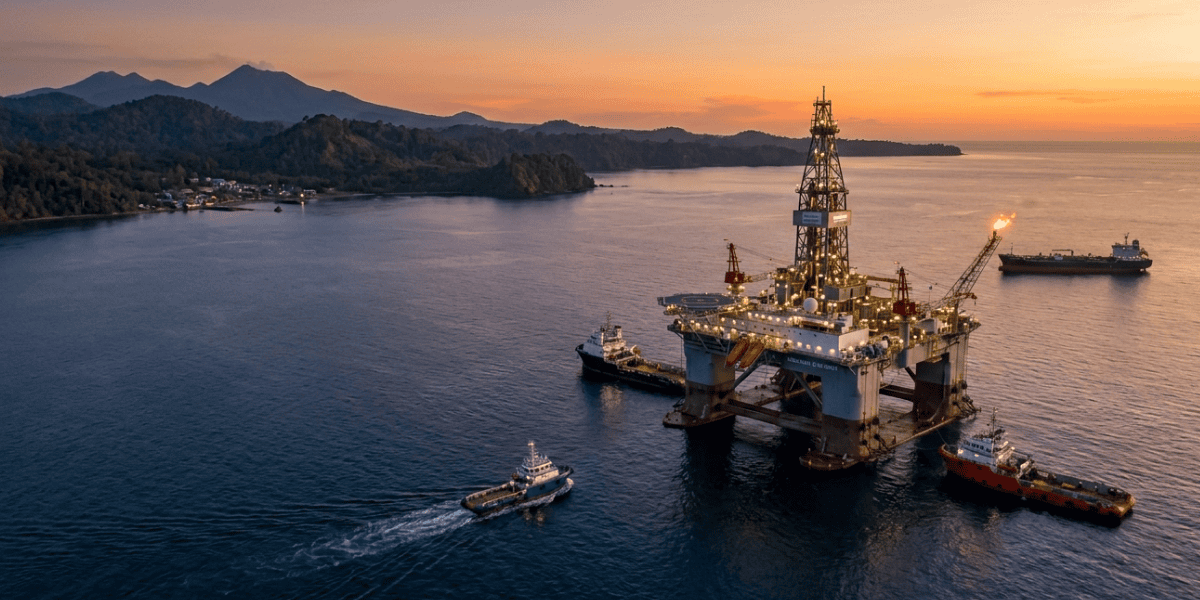
The strongest commercial momentum in the basin currently lies in Indonesian waters. Abu Dhabi-based Mubadala Energy has made significant discoveries in the South Andaman block offshore North Sumatra. The company announced a major gas discovery at the Layaran-1 well in 2023, followed by another discovery at the Tangkulo-1 well in 2024.
Industry observers believe these discoveries could represent one of Southeast Asia’s most important recent deepwater gas finds. Mubadala has since expanded its presence in the basin through additional exploration licences, including the Central Andaman block where Harbour Energy serves as operator.
The discoveries have helped transform perceptions of the Andaman basin from a high-risk frontier into an emerging gas province. Development planning for these discoveries is now being examined, raising the possibility that commercial production in the Indonesian section of the basin could begin later in the decade.
Indonesia’s success has also reinforced the idea that the broader Andaman basin may contain significant hydrocarbon resources, encouraging exploration interest from neighbouring countries.
India exploration push
India is now intensifying exploration in its section of the basin around the Andaman and Nicobar Islands. The offshore waters near the islands have long been regarded as geologically promising but remain relatively underexplored because of deepwater conditions and the high cost of drilling.
The Directorate General of Hydrocarbons has offered several Andaman basin blocks under recent Open Acreage Licensing Policy rounds, covering large offshore areas. State-run exploration companies Oil and Natural Gas Corporation (ONGC) and Oil India Limited are preparing to expand drilling activity in these offshore regions.
In 2025, India reported the presence of natural gas during drilling in the Andaman basin near Sri Vijaya Puram. While further appraisal is required to determine the commercial scale of the discovery, the find has strengthened expectations that the basin may contain sizeable gas resources.
India is also exploring technical collaborations with global energy companies to support deepwater exploration campaigns in the region. Given the high capital requirements and complex geology involved in offshore drilling, partnerships with international firms are likely to play an important role in developing the basin.
Thailand exploration plans
Thailand has also begun turning its attention toward the Andaman Sea as it looks to secure future domestic energy supplies. The country’s existing gas reserves in the Gulf of Thailand are gradually declining, prompting policymakers to consider new exploration opportunities.
Thai authorities have indicated plans to open petroleum exploration blocks in the Andaman Sea in the coming years. Although exploration activity in Thailand’s section of the basin remains at an early stage, the move signals that the Andaman Sea is becoming a broader regional energy focus rather than a frontier limited to one or two countries.
Myanmar also lies within the wider geological arc of the Andaman basin, and the country already hosts major offshore gas projects in the Rakhine basin. While Myanmar’s projects are geographically distinct, they form part of the broader energy system surrounding the Andaman Sea.

Regional energy stakes
Several key players are now shaping the emerging energy landscape of the Andaman basin. Mubadala Energy currently stands out as one of the most active explorers due to its discoveries in Indonesian waters. Harbour Energy is another important participant through its operating role in the Central Andaman block.
On the Indian side, ONGC and Oil India remain the principal exploration companies, supported by the Directorate General of Hydrocarbons and the Union Ministry of Petroleum and Natural Gas. If exploration success continues, international energy majors could also become more involved in the basin.
The most likely outcome for the Andaman basin is the emergence of a gas-focused energy province rather than a rapid oil boom. Current discoveries in the Indonesian sector are primarily gas fields, and early indications from India’s exploration activities also point toward natural gas resources.
However, the development of the basin is expected to unfold gradually. Deepwater offshore projects require complex drilling operations, substantial capital investment and extensive infrastructure development. Even after discoveries are confirmed, it often takes several years before production begins.
Nevertheless, the Andaman basin is steadily moving from geological curiosity to strategic energy zone. As exploration expands across India, Indonesia and Thailand, the region could eventually become an important contributor to Asia’s natural gas supply.
For India in particular, developments in the basin carry both economic and strategic significance. Any large-scale discoveries near the Andaman and Nicobar Islands would not only strengthen domestic energy security but also reinforce the islands’ importance in India’s wider maritime and economic strategy in the eastern Indian Ocean.