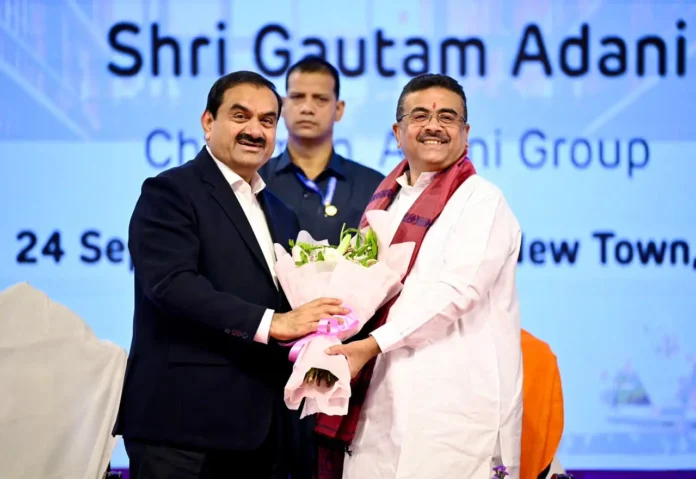
Kolkata, Sept. 24: The Adani Group on Thursday announced plans to establish the Adani Arogya Mandir, a 2,000-bed not-for-profit medical institution in Kolkata, with an investment of more than ₹4,000 crore in the hospital, medical college and research facilities.
Addressing the gathering in Kolkata, Gautam Adani said the proposed institution would combine advanced healthcare, medical education and research, with half of its beds earmarked for economically weaker sections eligible under State and Central health insurance schemes.
The facility is also planned to house a medical college and advanced research and care facilities, with the stated objective of creating a highly skilled healthcare workforce in West Bengal.
According to Adani, the project is expected to generate more than 10,000 jobs across the healthcare ecosystem.
The announcement has significance beyond West Bengal, particularly for regions such as the Andaman and Nicobar Islands, where access to advanced and specialised medical care remains closely linked to mainland connectivity.

For island residents requiring highly specialised treatment, Kolkata has historically been one of the important mainland healthcare destinations because of its geographical proximity compared with several other major Indian cities. A large tertiary-care institution offering advanced treatment, medical specialists, diagnostic facilities and research capabilities could therefore potentially provide an additional healthcare option for patients from the islands who require treatment unavailable locally.
The proposed medical college and research component could also be relevant in the longer term. A stronger healthcare ecosystem in Kolkata could expand access to specialised expertise and create opportunities for professional collaboration, referrals, training and medical education involving healthcare institutions and personnel from the Andaman and Nicobar Islands.
However, the Adani Group’s announcement does not currently specify any dedicated healthcare arrangement, referral mechanism or concession for patients from the Andaman and Nicobar Islands. The possible benefits for island residents would therefore depend on future accessibility, treatment costs, insurance coverage, referral arrangements and connectivity between the islands and Kolkata.
The development comes at a time when the need for advanced healthcare access remains an important issue for geographically isolated communities. While the Andaman and Nicobar Islands have government hospitals and healthcare facilities, patients requiring highly specialised procedures and treatment are often referred to mainland centres depending on the nature and complexity of their medical requirements.
Adani, in his address, described the proposed institution as the beginning of the group’s larger commitment to West Bengal. He said the group expects to invest more than ₹1 lakh crore in the state by 2035 across ports, logistics, power generation, transmission and distribution, roads, bridges, ropeways, green cement and hyperscale data centres.
He also highlighted Bengal’s geographical position as a maritime and logistics link between India’s industrial heartland, the Northeast and the Bay of Bengal, as well as its connectivity with Southeast Asian maritime trade routes.
The healthcare project, however, remains the most direct social-sector component of the announcement.
The proposed 2,000-bed capacity, including 1,000 beds for economically weaker sections covered under eligible government health insurance schemes, could increase the availability of affordable tertiary healthcare in eastern India.

For the Andaman and Nicobar Islands, the development also highlights the importance of strengthening mainland healthcare linkages alongside improving healthcare infrastructure within the islands. Better air connectivity, predictable fares and reliable patient-transfer arrangements would be critical if island residents are to access major specialised medical centres in mainland cities.
The Adani Group has said the Arogya Mandir will be built as a not-for-profit institution, combining treatment with medical education and research.
The project is thus positioned not merely as a hospital but as an integrated healthcare institution, with the potential to serve as a major medical hub in eastern India.
For island communities, its eventual value will depend not only on the availability of specialised treatment but also on whether patients from remote and geographically isolated regions can access such facilities affordably and without prolonged logistical hurdles.