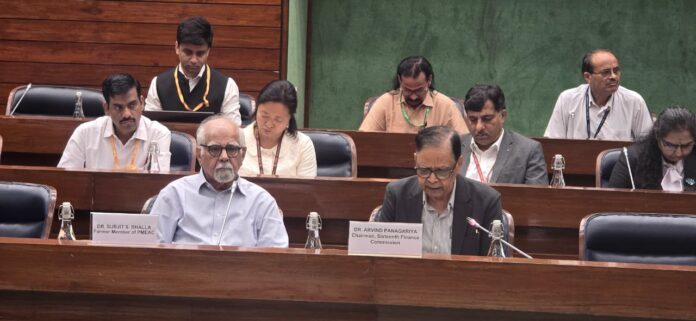
The Joint Parliamentary Committee (JPC) on One Nation, One Election (ONOE), chaired by BJP MP P.P. Chaudhary, on Thursday heard strong arguments in favour of simultaneous Lok Sabha and state Assembly polls from leading economists Arvind Panagariya and Surjit Bhalla. Both experts maintained that synchronising elections would reduce political and economic disruptions, ensure stability in policymaking, and curb electoral violence.
Panagariya, who currently heads the 16th Finance Commission, highlighted that India undergoes 13 rounds of elections in a five-year cycle, one roughly every 4.5 months. This, he said, creates a near-constant imposition of the Model Code of Conduct (MCC), disrupting governance, delaying reforms, and even stalling decisions of constitutional bodies like the Finance Commission.
He recalled that during the 1957 general elections, the Constitution’s framers permitted premature dissolution of certain state Assemblies so their polls could align with the Lok Sabha. Had they foreseen today’s continuous cycle, he argued, they might have supported a framework similar to that proposed under the 129th Constitutional Amendment Bill, which seeks to institutionalise simultaneous elections.

According to Panagariya, frequent polls lead to distortions in government spending, as fiscal outlays typically rise before elections to boost short-term growth. This, he said, contributes to higher deficits and delays in reform initiatives. A once-in-five-years election model, in contrast, would provide governments with a longer and clearer policy horizon, encouraging private investment and reducing subsidy pressures.
Surjit Bhalla, economist and former Executive Director at the International Monetary Fund (IMF), echoed these views. He clarified that the problem was not the Lok Sabha elections, which already take place every five years, but the staggered schedule of state polls. MCC restrictions, he said, affect states more severely than the Union, where elections follow a fixed timeline.

Calling frequent elections “a luxury we can no longer afford,” Bhalla emphasised that ONOE could significantly reduce the financial and social costs of polling. He warned that elections often trigger violence and impose opportunity costs on migrant workers who are drawn into electoral processes. Reduced election frequency, he argued, would help mitigate such challenges.
Both economists concluded that ONOE has the potential to strengthen democracy by lowering uncertainty, fostering reforms, and ensuring that elected representatives focus on governance rather than continuous campaigning.