Sri Vijaya Puram, November 19: More than 130 years after the British introduced the Prisons Act of 1894, the Andaman and Nicobar Islands are set to replace their colonial-era prison framework with a new law that introduces tougher penalties for contraband, including unauthorised mobile phones, while placing greater emphasis on rehabilitation, healthcare and prisoners’ rights.
The Andaman and Nicobar Islands Prisons and Correctional Services Regulation, 2026, promulgated by President Droupadi Murmu and published in the Gazette of India on November 17, provides for imprisonment of up to three years and fines of up to Rs 25,000 for specified offences involving prohibited articles and unauthorised communication inside prisons.
The legislation marks a shift from a system historically centred on confinement, punishment and control towards one that also recognises rehabilitation, human dignity and opportunities for reform.
The change carries particular historical significance for the islands, home to the Cellular Jail, popularly known as Kala Pani, where the British incarcerated freedom fighters under harsh conditions during India’s independence struggle.
The new framework reflects a different approach to imprisonment, recognising that the lawful deprivation of liberty should not mean the denial of basic rights, healthcare, education or opportunities to rebuild one’s life after release.
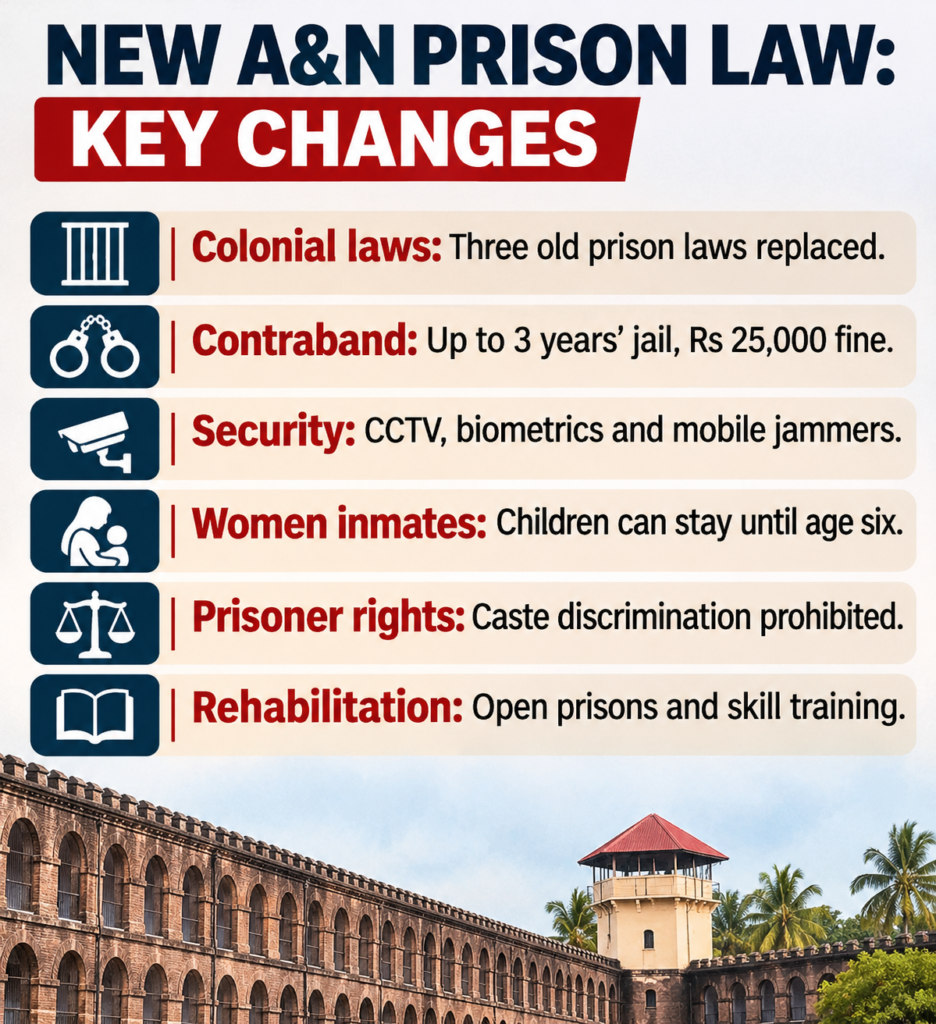
Enacted under Article 240 of the Constitution, the Regulation repeals three older laws applicable to the Union Territory: the Prisons Act, 1894, the Prisoners Act, 1900, and the Transfer of Prisoners Act, 1950.
However, the Regulation will not take effect immediately. The Administrator will notify its commencement, and different provisions may be implemented on different dates.
Security and penalties
The Regulation prohibits prisoners from possessing or using unauthorised mobile phones and other electronic communication devices inside prisons. It also provides for criminal prosecution of visitors, prison officials and staff involved in introducing prohibited articles, facilitating unauthorised communication or allowing such devices into prison premises.
Specified offences carry imprisonment of up to three years, a fine of up to Rs 25,000, or both. For certain offences involving electronic and wireless communication devices and their components, imprisonment ranges from two to three years. These offences are classified as cognizable and non-bailable.
Prison authorities may also impose disciplinary penalties following an inquiry, including warnings, restrictions on visitors, suspension of recreational and canteen facilities, forfeiture of remission and separate confinement.
The law requires prison administration to be computerised and integrated with the Interoperable Criminal Justice System to improve information-sharing and prisoner management.

Prisons will be equipped with biometric identification, CCTV surveillance, radio-frequency identification systems, scanning equipment, video-conferencing facilities and advanced cellular jamming and detection technology to prevent unauthorised communication.
Authorities must conduct periodic searches for contraband, coordinate intelligence-gathering with the Police Department and rotate staff deployed in sensitive barracks to prevent collusion between inmates and prison personnel.
The law also introduces risk-based prisoner classification. High-risk prisoners, hardened criminals, habitual offenders and repeat offenders must be housed separately, with enhanced surveillance and security arrangements.
Where standalone high-security prisons are unavailable, such inmates must be segregated from young and first-time offenders.
Rehabilitation and rights
A major departure from the colonial prison framework is the emphasis on correctional services, education and preparing prisoners for life after incarceration.
The Regulation provides for open and semi-open correctional institutions, individual sentence planning, vocational training, skill development and educational programmes. It also envisages after-care services to help released prisoners rebuild their lives and reintegrate into society.
Healthcare provisions include medical treatment, mental health support and arrangements for transferring prisoners requiring specialised psychiatric care to appropriate establishments, subject to legal safeguards.
Women prisoners must receive separate accommodation, gender-responsive healthcare, maternity care and access to mechanisms for reporting sexual harassment.
Women inmates may keep their children with them until the age of six, with provisions for the children’s healthcare and other essential facilities.
Transgender prisoners must have separate accommodation and access to healthcare, psychosocial support and correctional programmes.
The law also requires accessible infrastructure for prisoners with disabilities, including cells, toilets, medical units, training centres and grievance mechanisms. Prison authorities must screen inmates for disabilities at admission and provide appropriate staff training.
Significantly, the Regulation expressly prohibits caste-based discrimination, segregation and assignment of prison work on caste grounds. Manual scavenging and hazardous cleaning of sewers and septic tanks inside prisons are also prohibited.
These safeguards reflect Supreme Court directions concerning caste discrimination and the rights of prisoners with disabilities.
The Regulation provides for regular parole of up to 30 days at a time, not more than twice annually, for eligible convicts. Emergency parole may extend to 48 hours, while furlough of up to 14 days annually may be granted after three years of incarceration.
High-risk prisoners, hardened criminals and habitual offenders will not ordinarily qualify for prison leave.
The law also provides for free legal aid and district-level Under Trial Review Committees headed by the District and Sessions Judge. These committees will periodically examine eligible cases, including prolonged detention, and recommend appropriate action.
Prisoners will have access to supervised physical and virtual communication with family members and legal counsel. Foreign prisoners will also be able to communicate with their families and consular representatives under prescribed conditions.

To strengthen accountability, the Regulation provides for Boards of Visitors headed by judicial officers, departmental inspections, reporting of prisoner deaths and grievance redressal mechanisms for prisoners and prison staff.
It also addresses staff training, welfare and emergency preparedness.
The framework is based on the Union Home Ministry’s Model Prisons and Correctional Services Act, 2023, which seeks to modernise prison administration across the country.
Existing rules and administrative orders will continue until replaced or amended, provided they do not conflict with the new Regulation.
For the Andaman and Nicobar Islands, the legislation represents a significant departure from the colonial philosophy of imprisonment associated with Kala Pani. Its effectiveness, however, will depend on the rules subsequently notified, the resources committed and the ability of the prison administration to translate the new safeguards into practice.