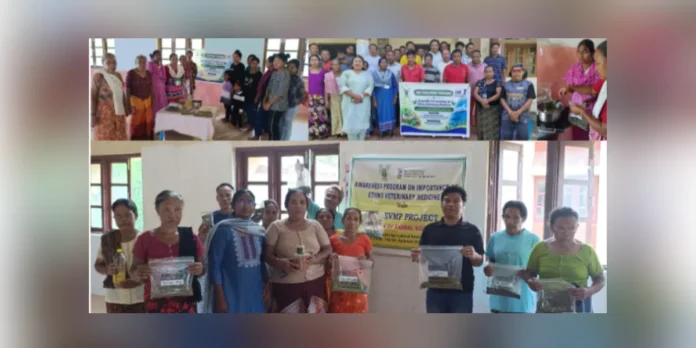
Car Nicobar, October 22: Traditional veterinary knowledge among Nicobarese tribal communities was the focus of a five-day skill development programme in Car Nicobar, where around 200 tribal men, women and youth, including traditional healers, received training in converting herbal oils into scientifically validated ointment formulations for livestock treatment.
The programme, conducted from October 16 to 20 by the ICAR-Central Island Agricultural Research Institute (ICAR-CIARI), formed part of a Department of Science and Technology (DST) initiative aimed at improving socioeconomic opportunities and promoting self-employment through scientific validation of indigenous veterinary knowledge and herbal product development.
Training sessions covered preparations traditionally used for conditions such as swelling, wounds and snakebites. Participants received practical instruction in converting herbal oils prepared through indigenous methods into ointments using scientifically validated techniques.

The sessions also addressed methods of drying and preserving medicinal plants and storing prepared ointments for use during emergencies.
Organisers encouraged younger members of the Nicobarese community to learn traditional veterinary formulations from experienced healers to preserve indigenous medicinal knowledge across generations.
The programme reached Malacca, Perka, Tamaloo, Small Lapathy, Big Lapathy, Kimious, Arong Sawai, Tapoiming, Kinyuka, Chukchucha, Kakana and Mus, with the participation of the respective tribal captains.

T. Sujatha, Principal Scientist and Principal Investigator of the DST-SSNT project, directed the training. Santosh Kumar, Senior Scientist and Head of Krishi Vigyan Kendra, Car Nicobar, served as course facilitator, supported by Deepoo Meena, Ajmal S. and Sankeeth G.D.
ICAR-CIARI Director Jai Sunder provided overall guidance for the initiative.
The project seeks to combine traditional Nicobarese veterinary practices with scientific formulation methods to support livestock healthcare, improve productivity and create livelihood opportunities in remote island communities.